Showing posts with label Atrahasis. Show all posts

Wednesday, September 16, 2015

Genocide for Kids

The story of Noah’s Ark is a popular one for children, perhaps because there’s a boat full of animals and kids like animals. In illustrations for children’s bibles and Sunday School lessons, the animals featured on the Ark will invariably be large mammals you would find at the zoo like elephants, giraffes, lions and tigers. God’s decision to wipe out all life on earth due to humanity’s sinfulness is presented matter-of-factly but the descriptions of the actual exterminations are left out. After the rain starts and the Ark door is closed, the story jumps ahead to the rain stopping, the release of birds and the rainbow.

What exactly are we trying to teach our children when we instruct them in the story of the Flood? A survey of some Sunday School lessons informs me that the themes are obedience and salvation. Noah was obedient to God when all his contemporaries were not and, as a result, God saved him and the animals. As a parent of a small child, I can understand why parents would want to teach the value of obedience to pre-schoolers. Small children don’t have much empathy for the “bad people” who literally missed the boat, if they even thought about it. Only adults wonder if all the people on earth before the Flood – even the infants and children – could really have been so evil that drowning them was God’s only option.
“The World is Destroyed by Water” (1866) by Gustave DorĂ©
Or, as a friend of mine placed the question in an article in his blog: 
How does the whole Flood thing lead anyone to think that Yahweh of the Old Testament is worthy of worship? It's more the action of a genocidal maniac, in my opinion -- killing everyone and everything, infants and children included, because of some perceived wickedness that couldn't be fixed any other way. 
It’s a valid question. Flooding the entire world to kill all human and animal life does seem to be a rather drastic solution. We can take some solace in the fact – based on geological evidence and implausibilities in the biblical text – that a worldwide flood never actually happened. That gets God off the hook for genocide, but doesn’t answer my friend’s question: Why would anyone worship a deity who would destroy all life on earth in a great flood?
The most chilling scene in “Noah” (2014) is in this homage to DorĂ© where a remnant of humanity clings to the rock right before a massive wave wipes them out. Their screams and cries can be heard in the ark far off in the distance.
If the flood story in Genesis was unique to Judaism out of all the religions in the world, that would be one thing, but flood stories can be found all over the world, in many different cultures. Besides the Genesis story of Noah, other well-known flood stories in the ANE are the Sumerian account of Ziusudra, the Gilgamesh flood myth, and the Atrahasis epic. The Atrahasis epic (1700 BCE) is similar to the Genesis primeval history (Gen 1-11) in that it combines a creation story along with a flood story. These flood myths were popular and translated into many languages, so it is almost guaranteed that the biblical writers knew of these tales and adapted them to suit the Yahwistic cult.

In the Atrahasis epic, humans were created to do menial jobs that the junior gods refused to do. With no set limit to their lifespans, the human race multiplied to the point where their noise interrupted the sleep of the senior gods. After unsuccessful attempts to control the population, they eventually decided to wipe out the human race with a great flood. One of the gods, Enki (or Ea), disagreed with this decision and, although sworn to secrecy, managed to instruct Atrahasis to build a boat before the flood arrives in seven days. After a fierce storm of 7 days and nights, the boat landed and Atrahasis offers sacrifice to the gods. The god Enlil, who had ordered the flood, is angered at Enki for foiling his plan and put limits on the human capacity to reproduce by creating infertility, infant mortality, and death.

There is conflict in the non-biblical flood myths between the council of senior gods who make the decision to destroy humanity and the renegade god who disagreed with the edict and worked against it. Enlil is the “bad god” and Enki, who sought to preserve life, is the “good god” who is worthy of worship. In the context of the Yahwistic cult, there is only one deity, so the biblical writer has to present both the decision to destroy the world with a flood and the decision to save representatives of the human race and the animal kingdom as those of YHWH. 

In the non-biblical flood myths, the decision to destroy the world is made for capricious or frivolous reasons. The biblical author alters this by providing the setting of worldwide evil, violence and corruption as moral justification for YHWH’s decision to obliterate life on earth and start over. At the end of the flood story, YHWH accepts the fact that humans are inclined towards evil and wiping them out is no longer a possible solution. The guarantee of the rhythm of seasons for as long as the earth endures is a sign of the new stability of nature in a recreated world.

Given the popularity of the Mesopotamian flood myths, the ancient biblical authors had to show how YHWH was different than the Sumerian or Babylonian gods. Ignoring the flood was not an option; the author had to provide a counter-narrative just as he did with the creation story. YHWH destroys, but he also saves at the same time; he is in control of every aspect of the flood event. If you worship the YHWH who saves, you are also worshipping the YHWH who destroys. 

That’s what happens when you take a myth meant to promote one deity over another and adapt it for a religion that worships only one deity. Later on, the devil would become the one who destroys, but when the Genesis Flood myth was written, the idea of the devil didn’t yet exist. That is a story for another time.

Tuesday, September 1, 2015

How the Mighty Have Fallen

In my very first article on this blog, I wrote: “I hope to shed light on obscure or downright weird passages in the Bible that make people scratch their heads.” Well, I think that description definitely applies to Gen 6:1-4. It is short enough to quote in its entirety:
When men began to multiply on the face of the ground, and daughters were born to them, the sons of God saw that the daughters of men were fair; and they took to wife such of them as they chose. Then the Lord said, “My spirit shall not abide in man forever, for he is flesh, but his days shall be a hundred and twenty years.” The Nephilim were on the earth in those days, and also afterward, when the sons of God came in to the daughters of men, and they bore children to them. These were the mighty men that were of old, the men of renown. (RSV)
The KJV translates Nephilim as “giants” due to the report in Num 13:33 describing the original inhabitants of Canaan: “All the people that we saw in it are of great size. There we saw the Nephilim … and to ourselves we seemed like grasshoppers, and so we seemed to them.” Nephilim means “the fallen ones,” the ones fallen in death, because every time the Nephilim – or similar names like the Anakim or Rephaim – are mentioned in the Bible, it is only to explain how one of the great heroes (like Moses or Joshua or David) wiped them out.
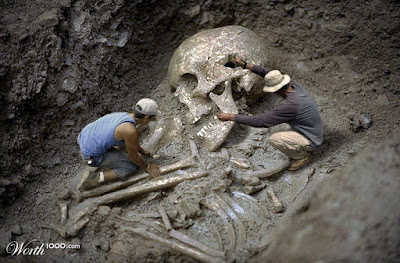
Fifth place entry in Photoshop contest on worth1000.com
"Giant Ancestors" by blackbook (5th place entry in a Photoshop contest on worth1000.com,)
Jews and Christians were scandalized by the thought of “sons of God” mating with mortal women and bearing giant demigod offspring. It is like a tale you would find in Greek mythology of the god Zeus mating with a mortal woman who then gives birth to a great hero like Heracles. Also, the idea of “sons of God” was anathema to monotheistic religions like Judaism or Christianity. So the interpretation took hold that the “sons of God” were actually angels who rebelled against God. Just as we’ve seen with other ancient “interpretations” of difficult biblical passages, there’s nothing in the text to support the idea of a rebellion in heaven. Plus, the idea of half-angelic, half-human offspring doesn’t really solve the “ick” factor.

So another interpretation developed whereby the “sons of God” were interpreted as members in the line descending from Seth, and the “daughters of men” were women descended in the line of Cain. In this interpretation, the offspring would be fully human. The scandal, if any, would be in the “pure” population of the Sethites becoming polluted with the “bad seed” of the Cainites. Again, nothing in the text supports this speculation and it doesn’t explain why children of these unions would be extraordinary warriors or giants.

We have clear evidence from elsewhere in the Bible that the “sons of God” really are divine beings, lesser gods in YHWH’s assembly (Job 1:6; Ps 29:1; Ps 89:7). They were present with YHWH at creation (Job 38:7) and the nations were divided up amongst them (Deut 32:8). The passage really is as scandalous as it appears to be. It recalls an older polytheistic tradition wherein YHWH was one god among many.

But why would the author repeat such a fragment of mythology? Vv. 1-2 and 4 seem to be an origin story of the Nephilim, the heroes of old, the warriors of renown. The author seems to recognize that v. 3 breaks up the flow of thought, because he recapitulates the first two verses in v. 4. V. 3 also appears out of place because YHWH seems to be punishing humans by limiting their lifespan to 120 years although it seems the “sons of God” are the guilty party here, using their power to take advantage of the subordinate mortals. So why isn’t YHWH punishing the divine beings instead?

Biblical scholar Ronald Hendel has a theory that this passage originally served as YHWH’s motivation for sending the Flood. There is a Babylonian flood story called the Atrahasis in which human overpopulation caused so much noise that the god Enlil lost his sleep. His final solution was to send a flood to wipe out all human life, but Atrahasis and his family escaped. Thereafter, death was instituted to prevent a repeat episode. We have allusions to this mythology in Gen 6:1-4 with the references to humans multiplying over the face of the earth and the restriction of human lifespans to (only) 120 years.

According to Hendel’s theory, the original story recounted the creation of demigods, the Nephilim. This creates an imbalance in the cosmos because the divine and mortal realms become intermingled. The solution to this problem was to destroy all living things with a flood in order to restore balance. The Yahwist (J) obscured the causal connection between the creation of the Nephilim and the Flood by providing a different reason for the Flood in vv. 5-7: YHWH saw the evil in humanity and regretted creating human beings, so he will wipe them off the face of the earth. The story of the Nephilim now becomes just one more example of the spread of evil. In J’s version, YHWH’s actions are morally justified because of the wickedness of human beings. Only Noah found favor in the eyes of YHWH.

The only remaining issue to clear up is the fate of the Nephilim. With only Noah and his family surviving the Flood, it seems that “the fallen ones,” true to their name, end up dead. So why are they still around to scare the living daylights out of the scouts Moses sends into Canaan? I guess we have to assume those randy “sons of God” couldn’t keep their hands off our women. As Gen 6:4a specifies, “The Nephilim were on the earth in those days—and also afterward [emphasis mine].” Nothing like a little editorial comment to bring consistency to the story.