Showing posts with label primeval history. Show all posts

Wednesday, October 28, 2015

Transition to History

The Hebrew word toledot means “generations” or “descendants.” In Genesis, it appears once in the conclusion of the Priestly (P) writer’s story of the creation of the universe, and nine other times at the beginning of a section of narrative or genealogy:
  1. Gen 2:4   These are the generations of the heavens and the earth when they were created.
  2. Gen. 5:1  This is the list of the descendants of Adam. (the period from Adam to Noah)
  3. Gen. 6:9  These are the descendants of Noah. (introduces the flood story)
  4. Gen. 10:1  These are the descendants of Noah’s sons, Shem, Ham, and Japheth... (the Table of Nations)
  5. Gen. 11:10  These are the descendants of Shem. (the period from Noah to Abraham)
  6. Gen. 11:27  Now these are the descendants of Terah. (introduces the Abraham cycle)
  7. Gen. 25:12  These are the descendants of Ishmael… (links Abraham to Arab tribes)
  8. Gen. 25:19  These are the descendants of Isaac, Abraham’s son… (introduces the Jacob cycle)
  9. Gen. 36:1  These are the descendants of Esau… (links Jacob to the Edomites)
  10. Gen. 37:2  This is the story of the family of Jacob. (introduces the Joseph story)
Functionally, the toledot formula serves as a means of linking the descendants of Jacob to the creation of the universe. Some English versions may translate toledot as “records” or “story,” so the link may not be as obvious in translation as it is in Hebrew.

Toledot written in Hebrew. Above it is the name of the first book in the Torah, Bereshit ("In the Beginning"). We call it Genesis. 

The formula also serves as a cue to the reader. Modern books have chapter and section headings to organize the material, but the biblical books made use of repeated phrases to inform their audience that one section was ending and another section beginning.

The first use of toledot at 2:4 is an especially odd one in that, instead of referring to the descendants of a person, it is referring to the “generations” or “begettings” of the heavens and the earth. It is also unusual in that it serves as a hinge, closing out the P creation account and opening the Yahwist (J) primeval story in Gen 2-4.

The last use of the toledot formula in the primeval story appears at 11:10. As you can see from the list above, it introduces vv. 11-26 which serve to connect Shem to Abraham. It serves as a transition from primeval time to historical time. Beginning with 11:27 which marks the opening of the cycle of stories associated with Abraham, we move into the time of the patriarchs and this will carry the story forward until the end of Genesis. Other appearances of the toledot formula will close out the Abraham cycle, begin and close the Jacob cycle, and introduce the Joseph story.


As far as the passage of 11:10-26 itself is concerned, there’s not much to say. It is a pure P genealogy with no variation to the rigid format. That said, there are some inconsistencies with other P genealogies and the biggest one concerns Arpachshad.

Back in 10:22 (another P passage), Arpachshad was listed as the third of Shem’s five sons: Elam, Asshur, Arpachshad, Lud, and Aram. In 11:10, it is recorded, “When Shem was 100 years old, he begot Arpachshad, two years after the flood.” The implication, of course, is that Arpachshad is the first-born, since genealogies are only concerned with the first-born son.

If that wasn’t enough, 5:32 states that Noah was 500 years old when he begot Shem. Gen 7:6 says that Noah was 600 years old when the flood came upon the earth. Simple arithmetic would give us the age of Shem as 100 when the flood began, yet 11:10 says that two years after the flood – a flood that lasted a year in P’s account – Shem was 100 years when he fathered Arpachshad.

This conundrum could tie a biblical literalist into knots trying to explain it. A non-literalist, however, could appeal to different traditions. But in this case, we are not dealing with the Yahwist (J) tradition on one hand and the Priestly (P) tradition on the other. All the passages cited come from P, so this passage actually demonstrates that the Priestly writer has several traditions before him that he is trying to preserve. We saw something similar in the Tower of Babel story where the J author was preserving separate traditions of how YHWH ended the tower-building project by either dispersing the population or confusing their language.

According to biblical scholars, in the P tradition that was taken up into the Table of Nations, Shem’s five sons represent five different nations: Elam (located in modern-day Iran), Asshur (Assyria), Arpachshad (Babylon), Lud (?), and Aram (Syria). But in the P tradition that appears in 11:10-26, Arpachshad is the name of a person who fathered Shelah.

The fact that P is combining and preserving pre-existing oral traditions that came to him demonstrates that the composition of the book of Genesis had a very complicated history. At the beginning of the process, you have a series of oral traditions that are handed down through the various tribes. At some point – probably around the time of David and Solomon – some of these traditions were written down by the Yahwist writer. Much later, around the time of the Babylonian exile, other traditions were preserved by the Priestly writer. Later still, the redactor (R) combined the J and P texts into Genesis as we have it today.

The inconsistencies and mismatches in the received text that are something of an embarrassment to biblical inerrantists allows the critical scholar to peer into the past to get a rough idea of how Genesis was put together. Or, as P would state it, “These are the generations (toledot) of Genesis when it was created.”

Wednesday, October 21, 2015

Tower of Power

According to Virgil, Aeneas was a prince of Troy who escaped the sacking of the city and eventually founded the city of Lavinium; it would be the parent city of Rome. A different tradition recounted the story of Romulus, who after killing his twin brother Remus, founded the city of Rome. Because the Trojan War is dated to hundreds of years before the traditional founding of Rome in 753 BCE, a line of fictional kings were manufactured to close the gap between Aeneas and Romulus and reconcile the two founding myths.

We have two founding myths for Babylon in Gen 10 and 11. Gen 10:8-12 gave us the story of Nimrod and how he founded his kingdom in Babel in the land of Shinar. Gen 11:1-9 recounts the story of a group of people who, travelling eastwards, stop in a plain in the land of Shinar and decide to construct a city and tower. After YHWH intervenes, the people are dispersed, their language confused, and the city became known as Babel because that word is similar to the Hebrew word balal, “confuse.” (Actually, the name of the city comes from the Akkadian babilam, the gate of the gods.)

There are three motifs that run through the story: 1) construction of a city with a tower that can reach to the heavens, 2) one language that gets confused into a multiplicity of languages, and 3) dispersion of the human race across the earth. These motifs are found in many stories around the world, but never together except in Genesis. For example, there are many myths about the attempt to construct a tower that can reach heaven, but these tales end with the destruction of the tower (and sometimes the builders), not with a confusion of languages or a dispersion of peoples across the earth. Those motifs are more likely to be the conclusion of a flood story.
A traditional portrayal of "The Tower of Babel" (1563), by Pieter Brueghel
Although all three motifs appear in Gen 11:1-9, the threads don’t intertwine seamlessly. For example, YHWH spots the people constructing the city and decides to confuse their language (v. 7), but then ends up scattering the people across the earth (v. 8). Despite having been physically scattered across the face of the earth and no longer in the land of Shinar, the author feels it necessary to explain that the builders abandon construction of the city. This explanation would make more sense if only their language had been confused yet they had remained in the same place.

Because of the disjunctions in the narrative, biblical scholars speculate that we are dealing with two independent stories that were combined at a really early period. In each story, the people want to construct a tower that can reach heaven and thus make a name for themselves. This challenges the bounds the creator has placed on the people, so in one story, the deity disperses the people across the face of the earth. In another story, the deity confuses their language so they can no longer work together and they abandon the building project.

The story probably does not originate in Mesopotamia, but the author is aware of their building techniques. In Israel, buildings are constructed of stone and mortar. Therefore the author has to explain to his audience that in the land of Shinar, fired bricks are used for stone and asphalt for mortar. The mention of Shinar also continues the process begun in Gen 10 of shifting the setting of the stories from some distant primeval time to historical time. This story occurs in a real place, although at some far-off time when all of humanity spoke the same language.
The Etemenanki ziggurat in the temple area in Babylon may have inspired the tale of the Tower of Babel. This impressive model of the ziggurat was constructed entirely of Legos by Michal Herbolt.
Hearing this story as a kid, it seemed fantastical to me that people were foolish enough to think they could construct a tower that would reach heaven. There was obviously no way that was going to work. An adult reader could be tempted to say that builders’ intent for a tower “with its summit touching the heavens” is just metaphorical language for a magnificent structure, but in the story YHWH is concerned enough that he felt it necessary to take steps to prevent the builders from completing their project. If you recall the cosmology of the ANE with a vaulted dome over the earth, it may have seemed feasible millennia ago that if mountains could scrape the clouds, maybe a tower could be built tall enough to allow humans to ascend to heaven.

In summary, what we have here is another etiological tale to explain how a situation in the author’s present-day – namely, the multiplicity of languages – came about. Just like we saw in Gen 3 with the explanations of why snakes crawl on the ground, women have pain in childbirth and men have to toil and sweat to work the ground, the many human languages are a result of YHWH’s punishment for human misdeeds. In this case YHWH is making a pre-emptive strike to keep humanity in its place. At the end of the Eden story (3:22-24), concerned with what his humans would try next, YHWH stationed an angel at the entrance of Eden to prevent humans from eating of the tree of life. In this tale of the tower of Babel, YHWH has to disperse the human race and confuse their languages because humans are capable of anything once they put their minds to it.

And, with that, we have our moral for the story. Humans in the Genesis stories have this annoying habit of not knowing their place, whether it is thirsting after knowledge (Gen 3), cavorting with divine beings (Gen 6), or building a tower that can reach heaven. YHWH has to continually intervene to restrict them within the boundaries set for them. The author recognizes that human beings are capable of both great and terrible accomplishments and this has resonance for our own time because we realize that humanity has the power to either save the world or destroy it. It is anyone’s guess which path we will choose.

Wednesday, October 14, 2015

We are Family

Chapter 10 of Genesis has been called the “Table of Nations,” consists of almost nothing but a list of 70 names (some of them repeated), and is a strong contender for one of the most boring parts of the Bible. The purpose of Gen 10 is to list the descendants of Noah’s three sons – Shem, Ham and Japheth – to show how the tribes, nations and peoples surrounding Israel derive from them. It is a mixture of a monotonous enumeration of names from the Priestly (P) source along with more names and scraps of narration from the Yahwist (J) source.

While scholars cannot identify every single name mentioned in Gen 10, they have been able to identify enough to get a rough idea of the lay of the land. As you can see in the accompanying map, the descendants of Japheth are the peoples to the north of Israel in Europe and Asia Minor. Ham’s descendants populate the northern-most parts of Africa and the area immediately surrounding the land of Canaan. The peoples descending from Shem occupy the lands of Mesopotamia and Arabia. These far-flung areas encompassed the known world in Solomon’s day (10th century BCE) but, for the modern reader, fail to take into account the Indian subcontinent, China and other Far Eastern nations, and the indigenous peoples of Australia and the Americas. The great flood is dated by biblical literalists to 2350 BCE, so all of these migrations and racial diversity would have had to take place since that time.
A rough approximation of where the various peoples mentioned in Gen 11 would have been located in the ancient world.

The literary genre may be that of a genealogy, but the names are not really individuals; they are the names of tribes and regions. In some instances, the writer doesn’t even pretend to provide the name of an individual. In v. 15, J states that Canaan is the father of Sidon (one of the ancient cities of Phoenicia) and Heth (representing the Hittites), as well as the father of several Canaanite tribes (Jebusites, Amorites, Girgashites, and Hivites). And, as if that wasn’t enough, Canaan was also the ancestor of the inhabitants of five Phoenician cities (Arkites, Sinites, etc.).

As mentioned above, there is some duplication of names due to different traditions in the two sources. According to P Lud (assumed to be a reference to inhabitants of Lydia in Asia Minor) are descended from Shem (v. 22), but according to J the Ludites are descended from Ham (v. 13). According to P Havilah and Sheba are descended from Ham (v 7), but J has them descended from Shem (vv. 28-29). It’s all quite confusing.
Presented graphically, the mind-numbing list of names is a little easier to digest.

The backbone of the Table of Nations is provided by P. He lists the sons of Noah in reverse order, from youngest to oldest. P announces the sons of Japheth, Ham or Shem and then selectively names some grandsons. The passage citing the sons of Japheth (10:2-5) is pure P. P ends each genealogical list with a formulaic conclusion: “These are the descendants of Japheth/Ham/Seth in their lands, with their own language, by their families, in their nations.” A similar formula concludes the chapter.

The list of Ham’s sons (vv. 6-20) is longer because it includes a lengthy addition (vv. 8-19) from the J source. This insertion breaks the monotony by providing us with a few lines (vv. 8-12) describing Nimrod, a mighty warrior and hunter and also the founder of the kingdom of Babel in Shinar (Babylonia) which expanded into Assyria and led to the building of Nineveh. Scholars are not in agreement as to whether the figure of Nimrod can be identified with either a mythological god or hero (like Gilgamesh) or some historical figure. Perhaps he just stands as the representative of the Babylonian nation. It is a bit odd, though, that Nimrod is included in the Hamite list but is said to have established a kingdom in Babylonia which is a Sethite region.

Two brief verses (13-14) relate the origins of the Philistines and the rest of the first J insertion (vv. 15-19) lists various tribes in the land of Canaan and its vicinity. While the division of peoples and nations appears to be along ethnic lines, there are curiosities. The Philistines were of Aegean origins, so they should be listed with Japheth’s descendants, not Ham’s. And the Canaanites were ethnically Semitic, so by all rights they should be counted among the descendants of Shem. Scholars believe that because the Canaanites were under the political control Egypt, the P source listed them as sons of Ham.

Shem is introduced at the ancestor of Eber (v. 21), who we will later see in Gen 11 is the ancestor of Abraham. Without the link to Eber provided by J, we would not know from reading P’s genealogy where to place Israel among Noah’s sons. In a J insertion (v. 26) we further learn that Eber is the father of Peleg during whose lifetime “the earth was divided” (Hebrew palag). This would have been about a hundred years after the flood event and seems to be a reference to the confusion of languages and scattering of peoples across the earth in the following episode of the Tower of Babel (11:1-9). That the descendants of Shem are to be found in Mesopotamia is consistent with the Bible’s claim that Abraham’s home town is Haran (or Ur, depending on the source).

The purpose of the Table of Nations seems to be rather straightforward. The biblical authors are demonstrating that all the known tribes, nations and ethnicities derive from the family of Noah. Therefore, all people are part of an extended family. But the rest of the OT stands diametrically opposed to this notion. Canaanites are not considered “cousins” of Israel, but abominations that needed to be driven out of the Promised Land or exterminated. Perhaps the writer is recalling an older tradition that acknowledged the ties between Canaanite and Israelite civilizations. In fact, archeologists cannot distinguish between Canaanite and Israelite culture; the two blend seamlessly from one into the other. 

Either that or the writer is speaking to his audience, an audience that is returning from exile in Babylon to the Promised Land, much as Abraham made that journey. When Abraham arrived in Canaan, he peacefully co-existed with the tribes there. The returning exiles would also arrive to find the land occupied by descendants of the Canaanites. Perhaps the writer wanted to remind his audience that they, too, could peacefully co-exist with the inhabitants if they remembered that they are all descendants of Noah.

Wednesday, October 7, 2015

Damned Ham

Okay, let’s say you and your family just survived a global cataclysm. What’s the first thing you do? Well, according to the Bible, it’s to get stinking drunk.

The first story the Bible recounts after the flood (Gen 9:20-27) is how Noah planted a vineyard, got drunk on wine, and lay naked in his tent:
Noah, a man of the soil, was the first to plant a vineyard.
He drank some of the wine and became drunk, and he lay uncovered in his tent.
And Ham, the father of Canaan, saw the nakedness of his father, and told his two brothers outside.
Then Shem and Japheth took a garment, laid it on both their shoulders, and walked backward and covered the nakedness of their father; their faces were turned away, and they did not see their father’s nakedness.
When Noah awoke from his wine and knew what his youngest son had done to him,
he said, “Cursed be Canaan; lowest of slaves shall he be to his brothers.”
And he said, “Blessed be YHWH, the God of Shem; and let Canaan be his slave.
May God make space for Japheth, and let him live in the tents of Shem; and let Canaan be his slave.”
There are some odd aspects of this passage. How does it relate to what’s happened previously?

Back in Gen 5:29, it was said that Lamech named his son Noah because “Out of the ground that YHWH has cursed this one shall bring us relief from our work and from the toil of our hands.” Thus Noah’s name is related to his role as the first winemaker (“wine to gladden the heart”, Ps 104:15) and not as the hero of the flood. Because of the mention of the name YHWH and the callback to the cursing of the ground in 3:17-19, this verse has been considered the one verse from the Yahwist (J) in all of Gen 5. Verse 29 seems to have been originally connected to 9:20-27 (another J passage) but got separated when the flood narrative was inserted. The description of Noah as the founder of viticulture is consistent with J’s list of the founders of cities, nomads, musicians, and metalworkers in 4:17-25.

Many commentators have wondered as to the nature of Ham’s crime that earned him such condemnation from Noah. Some have speculated if “saw the nakedness of his father” was a euphemism for something much worse. But the words can be taken literally and make perfect sense. While a husband and wife can be naked and not feel shame – as was the case of Adam and Eve – public nudity in the OT was seen as shameful. If a son was to see his father lying helplessly drunk and naked, the appropriate action was for the child to cover the genitals of the parent. Instead, Ham left Noah uncovered and told his brothers, thus publicizing Noah’s shame. We can speculate that Ham felt disgust or contempt for his father lying in that state, but that is reading more into the story than is there. Shem and Japheth, for their part, did what was expected of a good son.
"The Drunkenness of Noah" by Andre Sacchi (1599-1661). Seeing the look on Ham's face, I could see why Noah would curse him.

What’s odd is that Ham is introduced as “the father of Canaan” and, when Noah finally sobers up, he curses Canaan, not Ham. Ham is also referred to as Noah’s “youngest” son. This has led some biblical scholars to wonder if originally the story named Shem, Japheth and Canaan as Noah’s son. According to this theory, Canaan was changed to Ham in order to make the story consistent with the tradition that Noah’s sons were named Shem, Ham and Japheth. It is also equally possible that the story always concerned the sin of Ham and it was well-known that Ham was the father of Canaan (10:6). Just as Noah was dishonored by his son, he curses Ham’s son. It was only a later redactor who identified Ham as “the father of Canaan” for readers who were not clear on the genealogical connection.

The whole point of the story is the cursing of Ham/Canaan. The last two verses (which I placed in italics) is a secondary addition. Perhaps the redactor felt that if Canaan was cursed, Shem and Japheth needed to be blessed. But in v. 26 it is not Shem but YHWH who is blessed. YHWH is referred to as “the God of Shem” and since YHWH is only the God of Israel, Shem is identified with Israel. Biblical scholars declare that this is an etiological story of how Canaan came to be slaves to Israel. The problem with that theory is that in the rest of the OT, God tells Israel to either drive out or exterminate the Canaanites, never to make them their slaves.

The last verse is a play on the name Japheth (japt = “may he make large”). But who is Japheth? And why would he be dwelling in Seth’s tents? According to Gen 10:2-5, Japheth’s descendants were people to the north of Israel, but that comes from the Priestly writer. J may have had the Philistines in mind, for all we know. And perhaps the subject of v. 27a (“may God make space for Japheth”) is also the same subject of 27b (“and let him live in the tents of Shem”), in which case it would be a continuation of the blessing of YHWH in v. 26.

My final comment concerns the triple affirmation that Canaan is to be the lowest slave to Seth. In his primeval history, J continues to describe broken relationships and their consequences. In Gen 2-3, we had the broken relationship between the first couple and God and how it led to an inequality between husband and wife. In Gen 4, we have the broken relationship between brothers and how it led to Cain being outcast. Finally, here in Gen 9, we have a broken relationship between father and son and how it led to the son becoming slave to his brothers. Slavery was a reality in the ancient world but the author understands that it is not part of God’s original plan. Therefore, slavery must be punishment for some primordial sin. J is not challenging the institution. It exists in his world and he tries to explain how it came about.

Wednesday, September 30, 2015

Navel Gazing

Did Adam and Eve have navels? They didn’t need navels because they did not form in a womb, but there is a theory called the Omphalos hypothesis that claims the world was created with an apparent age: Adam and Eve with navels, trees with rings in the Garden of Eden, light from distant galaxies created en route. The Omphalos hypothesis is sort of a get-out-of-jail-free card for creationists, because any evidence a skeptic presents proving the age of the earth or universe can be shot down with the assertion that God simply created it to look antique, like a rustic distressed coffee table from Pottery Barn.

But the situation changes when you get to the Noachian deluge. Here we are no longer dealing with the story of creation where “apparent age” can be used as a trump card. In the flood story, we find claims that can be scientifically verified or discredited. If a worldwide flood happened, there should be some trace of it left behind, whether geological, ecological or zoological. Or, historical traces since, according to biblical literalists, the flood was supposed to have occurred between 2300 and 2350 BCE, well within the confines of recorded history.

Skeptics have presented dozens of challenges to the veracity of Noah’s flood and creationists have found “creative” ways of answering most of those questions…to their satisfaction anyway. For example, a skeptic may question whether a large wooden structure like the ark would be seaworthy. Beyond a certain size, wooden ships bend and leak. But a creationist can argue that the ark was made of “gopher wood” and this wood, which no longer exists today, may have been as hard as steel for all we know. Or Noah was a master craftsman or God gave him special knowledge to construct the ark. 
Pretty sure it didn't look like this. ("Noah's Ark - The Homecoming" by Steve Crisp)

In the creationist literature, many appeals are made along the lines of “we don’t know what conditions were like on the pre-Flood earth.” Where did all the water come from? Where did it go? Maybe the pre-Flood earth didn’t have very high mountains or the oceans weren’t as deep. The tremendous weight of the water forced the oceans to become deeper and pushed the mountains up, so the water drained away from the land naturally. But geological shifts of this magnitude would have destroyed any trace of human civilization before the flood. Recall the flood is dated to approximately 2350 BCE and the Great Pyramid of Giza dates to 2560 BCE, 200 years prior to the flood. Yet the pyramid is still there when, according to creationists it should have been destroyed in the flood cataclysm. According to Gen 10:6, the founder of Egypt was Noah’s grandson, so the entire history of Egypt should post-date the flood, but Egyptian history is well-documented back to 3100 BCE and shows no discontinuity.

Either the dating of the flood is wrong, a theory creationists are loathe to admit because that puts the reliability of the Bible’s dates into question, or the generally accepted dates – not only for Egyptian history, but also for other ancient civilizations – must be wrong. But that poses another problem because the Bible dates to Exodus to around 1450 BCE, 900 years after the flood. Events over 1500 years of recorded Egyptian history would have to be crammed into 900 years. Far less than 900 years actually, because rebooting the post-Flood world with only 8 people would require many generations before there was enough of a population to form distinct cultures and societies.

And then there’s the problem of the animals and whether the ark was big enough to hold them all. Creationists claim that Noah didn’t have to bring every type of animal aboard the ark, but only land mammals, birds, and reptiles. Insects and amphibians were left to fend on their own and fish like water. And Noah didn’t have to bring a representative of every species, but only every “kind” and they define “kind” at the taxonomic category of “family” or, at worst, “genus.” For example, if Noah was only required to bring a pair from the “cat” family (felidae), that would cover house cats, cheetahs, lions, tigers, leopards, etc. That stretches credulity a bit, so most creationists will accept (for the sake of argument) that Noah would have to bring representatives of each genus. That’s over 4000 genera for mammals, birds and reptiles and there would be at least a pair of each and seven pairs for the clean animals, so it would be more like 10-20,000 animals.

And not just representatives of every living genus, but every genus that ever existed, dinosaurs included. Why? Because creationists use the flood to explain fossils, so all those extinct animals – pterodactyls, T-Rex, mammoths – had to be alive at the time of the flood. And Noah would have to bring their representatives – juveniles, to save space – aboard the ark, even though they apparently didn’t survive conditions in the post-Flood world. (God should have informed Noah not to bother with them.) One creationist estimates 16,000 animals in all, representing living and extinct genera. The number seems on the low side to me, but let’s go with it.

Animals vary in size, but creationists like to use a sheep as an average size. The ark had a volume of 1.5 million cubic feet, which they say is equivalent to 570 railroad stock cars, each of which can carry 240 sheep. That works out to 11 cubic feet per animal, so if you have 16,000 animals, they would need 176,000 cubic feet. It sounds like there would be a lot of room left over on the ark, but Noah had to provision food for one year. A human can eat 8 times his weight in food over a year and an ox or cow twice that, so factoring in 8 times the space required for each animal for food, you arrive at 1.4 million cubic feet. This uses up all the space on the ark, with no space left for corridors, ramps, ventilation, water reservoirs or waste storage. Perhaps God put the animals in suspended hibernation – like astronauts in a science fiction movie – so they would not require food or water. But if God could whip out a miracle to save the day, why put Noah through the trouble of constructing an ark in the first place? Why not transport Noah and the animals to the tallest mountain and have them wait it out?

Once the ark landed and the animals disembarked, you would expect to see population densities in decreasing amounts as you travel further away from the site where the ark settled, but that is not the case. Marsupials managed to travel across oceans to South America and Australia, about as far as you can get from the Middle East, without stopping to settle anywhere along the way. God could certainly have infused a migratory impulse within the kangaroos and koalas to head to Australia and use ice ages to conveniently create land bridges for them to cross oceans, but that’s taking special pleading to ridiculous levels. A more plausible scenario is that humans brought the animals with them, but if that is the case, why did they only bring marsupials and not placental mammals? And how did flightless birds – penguins – get to Antarctica?

This brings us back to the Omphalos hypothesis. What young earth creationists are asking us to believe is that not only did God manage to set up the conditions on a pre-Flood earth that would have made a worldwide flood possible, but God also did an excellent job of eliminating all evidence of a global flood. The flood obliterated any trace of the pre-Flood world while, at the same time, laid down a sedimentary and fossil record that gives the appearance that animals went extinct over a long period of time. Recorded human history begins, not with a few survivors trying to rebuild civilization after the flood, but with well-organized societies of thousands of people building massive structures like the pyramids. Within an incredibly short period of time after the flood, animals and humans spread throughout the globe, crossed vast oceans and rapidly adapted to specific environments.

Is God is setting up a series of logically absurd situations in order to test our faith in the veracity of the Bible? The answer is clearly laid out in this quote from creationist literature: “The principal error of this view is that it starts from supposed scientific anomalies, such as the fossil record, rather than from Scripture.” In other words, Scripture drives the interpretation of science, not the other way around.

Wednesday, September 23, 2015

What is Gopher Wood?

In northern Kentucky, the Creation Museum is building a full-size replica of Noah’s Ark, based on the specifications provided in Genesis 6:14-16:
Make yourself an ark of gopher wood; make rooms in the ark, and cover it inside and out with pitch. This is how you are to make it: the length of the ark three hundred cubits, its breadth fifty cubits, and its height thirty cubits. Make a roof for the ark, and finish it to a cubit above; and set the door of the ark in its side; make it with lower, second, and third decks. (RSV)
There’s not a whole lot of detail and it allows plenty of room for imagination. The Creation Museum ended up with a vaguely Egyptian-looking design. The Bible doesn’t define the length of a cubit but it is the length from the elbow to the tip of the fingers. If the standard measure is 18 inches, the dimensions of the ark would be 450 x 75 x 45 feet. The Creation Museum chose an Egyptian cubit of 20.4 inches, so that makes their Ark 510 feet long. By contrast, the Titanic was 850 feet long, but was made of steel. Noah’s Ark would have been bigger than any wooden ship that has ever been constructed.
“Entry of the Animals” to Noah’s Ark by Athanasius Kircher (1602-1680)
As you can see, the biblical description leaves a lot of wriggle room. And the dimensions and the description of the door and three decks are the clearest parts. The rest of the passage uses some rare words (that I have emphasized in bold), the meanings of which are much debated.

The Hebrew word translated “ark” is tebah. It is used many times in Genesis 6-9, but outside of the flood narrative, it only occurs in Exodus 2:3, 5 to describe the basket in which baby Moses was placed. (The word translated “ark” in Ark of the Covenant is a completely different Hebrew word.) Tebah is a loan word from the Egyptian language to describe a box or chest. The Vulgate translates it as arca, from which we get the word “ark.” To be consistent, the word should be translated as “box” in both Genesis and Exodus. While tebah does not mean a ship, functionally it serves as a lifeboat in both cases.

Next up, the ark is to be constructed of “gopher wood.” What the heck is gopher wood? “Gopher” is a transliteration of the Hebrew word goper and no one knows for sure what it means, except that it has nothing to do with a burrowing rodent. Many English versions of the Bible (KJV, RSV, NJPS, NAB, NABRE) don’t try to translate it. A few others (NEB, NIV, NRSV) translate it as “cypress” wood, but that is just a guess. Hebrew does have a word for cypress, so if that’s what the Priestly writer wanted to say, he could have used that word.

The problem is that goper only appears here in the entire OT. Such a word is called a hapax legomenon (meaning “said once” in Greek). The most reliable way to translate a word is from its context, but how do you do that when you only have one context in which it occurs? Well, we can look to see how it was translated in ancient versions of the OT. The LXX translates it as “squared timber” and the Vg as “smoothed wood.” Both translations are describing not a particular type of wood, but wood prepared in some certain fashion. Because the LXX and Vg were closer to the time of the biblical writings, they may reflect a knowledge of the word no longer available to us or they may have simply guessed at the meaning of the word.

The Hebrew word translated “rooms” in many English versions (KJV, RSV, NRSV, NAB, NABRE, NJPS, NIV) is qinnim. This word is the plural of qen (“nest”) which elsewhere in the OT appears only in the singular. Since the original Hebrew only contained the consonants with the vowels added later, some scholars have proposed a different set of vowels that would yield the word qanim, “reeds” (NEB, NJB). This would yield a neat parallelism in the translation: “Make yourself an ark of gopher wood, with reeds make the ark.” The implication being that the ark would be constructed of both wood and reeds, perhaps with the reeds helping to seal the gaps between the wooden beams. Reeds were also used in the construction of the boats in the other flood myths like Atrahasis and Gilgamesh, so its use here could reflect an influence from those tales.

The Hebrew word (koper) translated “pitch” only appears here in the OT. It is not a hapax legomenon in the strict sense because the word is used twice in the verse, as verb and noun: “and pitch it on inside and out with pitch.” Koper is only one letter different from the hapax goper, so there is a bit of wordplay here. Pitch, tar, or asphalt are petroleum-based products. This poses something of a problem for Young Earth Creationists because they insist that all petroleum products were formed during the Flood. So where did a pre-Flood Noah get his pitch?

V. 16 gives us another hapax in tzohar, which the Vg translates as fenestra (“window”). Modern translators turn to a similar Arabic word which means the back of a hand or a human back. The logical conclusion is that tzohar was used to refer to the top or roof of the ark. The next part of the verse (“and finish it to one cubit from above”) is somewhat incomprehensible, so it is not clear if a gap between the roof and the sides is being discussed or an overhang of the roof. 

What are we to make of all the rare words? One possible explanation is that those words were in the tradition that the Priestly writer received. Just like if we were retelling the nativity story, we might say something like “the infant Jesus was wrapped in swaddling clothes and laid to rest in a manger.” “Swaddling clothes” and “manger” are not everyday words for most people but those words from the King James translation are such a part of the tradition that we would repeat them as-is. Something similar may be happening here with words like “gopher wood”.

Between the vague specifications and the rare words with contested or unknown meanings, we can only have a general idea of what Noah’s Ark was supposed to have looked like. But if you want to see the Creation Museum’s version, The Ark Encounter is scheduled for a grand opening in the summer of 2016.

Wednesday, September 16, 2015

Genocide for Kids

The story of Noah’s Ark is a popular one for children, perhaps because there’s a boat full of animals and kids like animals. In illustrations for children’s bibles and Sunday School lessons, the animals featured on the Ark will invariably be large mammals you would find at the zoo like elephants, giraffes, lions and tigers. God’s decision to wipe out all life on earth due to humanity’s sinfulness is presented matter-of-factly but the descriptions of the actual exterminations are left out. After the rain starts and the Ark door is closed, the story jumps ahead to the rain stopping, the release of birds and the rainbow.

What exactly are we trying to teach our children when we instruct them in the story of the Flood? A survey of some Sunday School lessons informs me that the themes are obedience and salvation. Noah was obedient to God when all his contemporaries were not and, as a result, God saved him and the animals. As a parent of a small child, I can understand why parents would want to teach the value of obedience to pre-schoolers. Small children don’t have much empathy for the “bad people” who literally missed the boat, if they even thought about it. Only adults wonder if all the people on earth before the Flood – even the infants and children – could really have been so evil that drowning them was God’s only option.
“The World is Destroyed by Water” (1866) by Gustave Doré
Or, as a friend of mine placed the question in an article in his blog: 
How does the whole Flood thing lead anyone to think that Yahweh of the Old Testament is worthy of worship? It's more the action of a genocidal maniac, in my opinion -- killing everyone and everything, infants and children included, because of some perceived wickedness that couldn't be fixed any other way. 
It’s a valid question. Flooding the entire world to kill all human and animal life does seem to be a rather drastic solution. We can take some solace in the fact – based on geological evidence and implausibilities in the biblical text – that a worldwide flood never actually happened. That gets God off the hook for genocide, but doesn’t answer my friend’s question: Why would anyone worship a deity who would destroy all life on earth in a great flood?
The most chilling scene in “Noah” (2014) is in this homage to Doré where a remnant of humanity clings to the rock right before a massive wave wipes them out. Their screams and cries can be heard in the ark far off in the distance.
If the flood story in Genesis was unique to Judaism out of all the religions in the world, that would be one thing, but flood stories can be found all over the world, in many different cultures. Besides the Genesis story of Noah, other well-known flood stories in the ANE are the Sumerian account of Ziusudra, the Gilgamesh flood myth, and the Atrahasis epic. The Atrahasis epic (1700 BCE) is similar to the Genesis primeval history (Gen 1-11) in that it combines a creation story along with a flood story. These flood myths were popular and translated into many languages, so it is almost guaranteed that the biblical writers knew of these tales and adapted them to suit the Yahwistic cult.

In the Atrahasis epic, humans were created to do menial jobs that the junior gods refused to do. With no set limit to their lifespans, the human race multiplied to the point where their noise interrupted the sleep of the senior gods. After unsuccessful attempts to control the population, they eventually decided to wipe out the human race with a great flood. One of the gods, Enki (or Ea), disagreed with this decision and, although sworn to secrecy, managed to instruct Atrahasis to build a boat before the flood arrives in seven days. After a fierce storm of 7 days and nights, the boat landed and Atrahasis offers sacrifice to the gods. The god Enlil, who had ordered the flood, is angered at Enki for foiling his plan and put limits on the human capacity to reproduce by creating infertility, infant mortality, and death.

There is conflict in the non-biblical flood myths between the council of senior gods who make the decision to destroy humanity and the renegade god who disagreed with the edict and worked against it. Enlil is the “bad god” and Enki, who sought to preserve life, is the “good god” who is worthy of worship. In the context of the Yahwistic cult, there is only one deity, so the biblical writer has to present both the decision to destroy the world with a flood and the decision to save representatives of the human race and the animal kingdom as those of YHWH. 

In the non-biblical flood myths, the decision to destroy the world is made for capricious or frivolous reasons. The biblical author alters this by providing the setting of worldwide evil, violence and corruption as moral justification for YHWH’s decision to obliterate life on earth and start over. At the end of the flood story, YHWH accepts the fact that humans are inclined towards evil and wiping them out is no longer a possible solution. The guarantee of the rhythm of seasons for as long as the earth endures is a sign of the new stability of nature in a recreated world.

Given the popularity of the Mesopotamian flood myths, the ancient biblical authors had to show how YHWH was different than the Sumerian or Babylonian gods. Ignoring the flood was not an option; the author had to provide a counter-narrative just as he did with the creation story. YHWH destroys, but he also saves at the same time; he is in control of every aspect of the flood event. If you worship the YHWH who saves, you are also worshipping the YHWH who destroys. 

That’s what happens when you take a myth meant to promote one deity over another and adapt it for a religion that worships only one deity. Later on, the devil would become the one who destroys, but when the Genesis Flood myth was written, the idea of the devil didn’t yet exist. That is a story for another time.

Wednesday, September 9, 2015

P, R and J Sandwich

The familiar Christmas story is taken from the first two chapters of Matthew and Luke. The magi, the slaughter of the innocents, and the flight into Egypt all come from Matthew. The census, birth in a stable, and shepherds all come from Luke. These individual elements from the two distinct infancy narratives fit well together in the traditional nativity story and it would be hard to identify them if we didn’t have the original narratives in Matthew and Luke.

We have a similar situation with the flood story in Genesis 6-9. Here we have elements from two different narratives – one from J and one from P – that were woven together by a redactor (“R” for short; redactor being another name for editor). Bible scholars can ascribe the verses to J or P based on the use of the divine name, themes, vocabulary or narrative style. Unlike the creation stories and genealogies where R left the J and P narratives stand on their own, in the flood narrative R used P as the main storyline and supplemented it with J at appropriate points. Sometimes R alternates several verses between J and P, but at other times he interweaves his source material. 

For example, R provides parallel accounts for the decision to destroy humanity. J’s account is in 6:5-8 and P’s version is in vv. 11-12. J emphasizes that YHWH is sorry that he had made humans. P repeatedly uses the word “corrupt” to emphasize his point: “Now the earth was corrupt in God’s sight, and the earth was filled with violence. And God saw that the earth was corrupt; for all flesh had corrupted its ways upon the earth.” 
“Building Noah’s Ark” by Franzosischer Meister (“The French Master”), 1675
These passages are followed by instructions for the building of the ark (vv. 13-22) taken from the P account. Similar instructions must have existed in J’s account, but R left them out. P delights in specifications for the length and width and height of the ark, along with the number of floors, window and door. The familiar command to bring aboard the ark “two of each kind” of bird, animal, and creeping thing recalls the similar enumeration of animals in P’s creation story in Genesis 1.

R returns to J’s narrative with the commission to enter the Ark in 7:1-5. Noah is instructed to bring a pair of unclean animals, but seven pairs of clean animals. “Clean” and “unclean” refers to whether the animals in questions are considered suitable for sacrifice. You would expect that the Priestly writer would be more concerned about ritually “clean” vs. “unclean” animals, but for P those categories did not exist until Moses was given the Law on Sinai. J’s rationale for having Noah bring aboard seven pairs of clean animals is to allow for their use in a sacrifice to YHWH after the flood (8:20-21).

With the description of the coming of the flood in 7:6-24, R repeatedly switches back and forth between P and J, sometimes in the middle of the same sentence. Here is what J’s portion of this passage would look like:
And Noah went into the ark to escape the waters of the flood and YHWH shut him in. The rain fell on the earth forty days and forty nights. And the waters increased, and bore up the ark, and it rose high above the earth. He blotted out every living thing that was on the face of the ground. Everything on dry land in whose nostrils was the breath of life died. Only Noah was left, and those that were with him in the ark.
In J’s account, YHWH personally seals Noah and his family into the ark. The flood is brought about by rain for forty days and nights. The reference to blotting out all creatures “in whose nostrils was the breath of life” recalls how YHWH breathed life into the earth creature in J’s creation account (Gen 2:7).

P’s narrative in the remainder of 7:6-24 illustrates his style of providing exact dates (“In the six hundredth year of Noah’s life, in the second month, on the seventeenth day of the month”) and numbers (“fifteen cubits deep”). P’s flood is not just a very long rain, but a return to the chaos prior to creation as windows in the firmament are opened to allow the upper waters to pour down and the lower waters below the earth are allowed to erupt. Unlike J’s forty days, P’s flood lasted for 150 days and took an equivalent amount of time for the waters to recede. The earth was dry (that is, the flood over) on the first day of the first month (8:13). Just as Gen 1 provided the context for the Sabbath observance, the flood story provides the context for the New Year’s festival because God is creating the world anew.

The ark soon came to rest on “the mountains of Ararat” (“Ararat” is a region, not a specific mountain). In the J account (8:6-12) Noah experiments with birds to discern when it is safe to exit the ark, but in the P account (8:15-19) God simply tells Noah when it is time to disembark. This is followed by J’s report of Noah’s thanksgiving sacrifice and YHWH’s promise not to again destroy the earth (20-22). The parallel passage from P narrates God’s renewed blessing of Noah (9:1-7) and his covenant to never again destroy the earth with a flood (8-17).
Sandwich structure of the flood narrative
In this article I focused on the separate J and P traditions so you could see the distinctiveness of each. But we also have to look at the complete text as it came down to us from R. There is artistry here. R did not simply grab bits and pieces from each tradition and insert them willy-nilly, but chose them to fit a chiastic pattern (or “sandwich” structure) with “God remembered Noah” at the center. It is not that God had forgotten about Noah; “remember” in this context means refers to God’s mercy towards one in danger of death (see Gen 19:29). It is the pivotal moment of the story because from here on, God’s attention is on reversing the destructive actions of the flood.

The flood story itself is pivotal in that it separates the primeval events “before the flood” from historical events “after the flood.” The world following the flood is the world in which we live.

Tuesday, September 1, 2015

How the Mighty Have Fallen

In my very first article on this blog, I wrote: “I hope to shed light on obscure or downright weird passages in the Bible that make people scratch their heads.” Well, I think that description definitely applies to Gen 6:1-4. It is short enough to quote in its entirety:
When men began to multiply on the face of the ground, and daughters were born to them, the sons of God saw that the daughters of men were fair; and they took to wife such of them as they chose. Then the Lord said, “My spirit shall not abide in man forever, for he is flesh, but his days shall be a hundred and twenty years.” The Nephilim were on the earth in those days, and also afterward, when the sons of God came in to the daughters of men, and they bore children to them. These were the mighty men that were of old, the men of renown. (RSV)
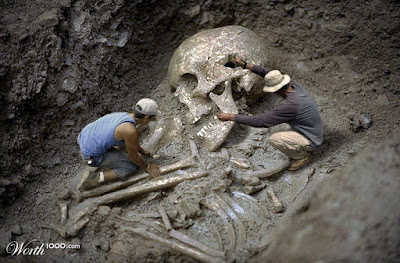
The KJV translates Nephilim as “giants” due to the report in Num 13:33 describing the original inhabitants of Canaan: “All the people that we saw in it are of great size. There we saw the Nephilim … and to ourselves we seemed like grasshoppers, and so we seemed to them.” Nephilim means “the fallen ones,” the ones fallen in death, because every time the Nephilim – or similar names like the Anakim or Rephaim – are mentioned in the Bible, it is only to explain how one of the great heroes (like Moses or Joshua or David) wiped them out.
Fifth place entry in Photoshop contest on worth1000.com
"Giant Ancestors" by blackbook (5th place entry in a Photoshop contest on worth1000.com,)
Jews and Christians were scandalized by the thought of “sons of God” mating with mortal women and bearing giant demigod offspring. It is like a tale you would find in Greek mythology of the god Zeus mating with a mortal woman who then gives birth to a great hero like Heracles. Also, the idea of “sons of God” was anathema to monotheistic religions like Judaism or Christianity. So the interpretation took hold that the “sons of God” were actually angels who rebelled against God. Just as we’ve seen with other ancient “interpretations” of difficult biblical passages, there’s nothing in the text to support the idea of a rebellion in heaven. Plus, the idea of half-angelic, half-human offspring doesn’t really solve the “ick” factor.

So another interpretation developed whereby the “sons of God” were interpreted as members in the line descending from Seth, and the “daughters of men” were women descended in the line of Cain. In this interpretation, the offspring would be fully human. The scandal, if any, would be in the “pure” population of the Sethites becoming polluted with the “bad seed” of the Cainites. Again, nothing in the text supports this speculation and it doesn’t explain why children of these unions would be extraordinary warriors or giants.

We have clear evidence from elsewhere in the Bible that the “sons of God” really are divine beings, lesser gods in YHWH’s assembly (Job 1:6; Ps 29:1; Ps 89:7). They were present with YHWH at creation (Job 38:7) and the nations were divided up amongst them (Deut 32:8). The passage really is as scandalous as it appears to be. It recalls an older polytheistic tradition wherein YHWH was one god among many.

But why would the author repeat such a fragment of mythology? Vv. 1-2 and 4 seem to be an origin story of the Nephilim, the heroes of old, the warriors of renown. The author seems to recognize that v. 3 breaks up the flow of thought, because he recapitulates the first two verses in v. 4. V. 3 also appears out of place because YHWH seems to be punishing humans by limiting their lifespan to 120 years although it seems the “sons of God” are the guilty party here, using their power to take advantage of the subordinate mortals. So why isn’t YHWH punishing the divine beings instead?

Biblical scholar Ronald Hendel has a theory that this passage originally served as YHWH’s motivation for sending the Flood. There is a Babylonian flood story called the Atrahasis in which human overpopulation caused so much noise that the god Enlil lost his sleep. His final solution was to send a flood to wipe out all human life, but Atrahasis and his family escaped. Thereafter, death was instituted to prevent a repeat episode. We have allusions to this mythology in Gen 6:1-4 with the references to humans multiplying over the face of the earth and the restriction of human lifespans to (only) 120 years.

According to Hendel’s theory, the original story recounted the creation of demigods, the Nephilim. This creates an imbalance in the cosmos because the divine and mortal realms become intermingled. The solution to this problem was to destroy all living things with a flood in order to restore balance. The Yahwist (J) obscured the causal connection between the creation of the Nephilim and the Flood by providing a different reason for the Flood in vv. 5-7: YHWH saw the evil in humanity and regretted creating human beings, so he will wipe them off the face of the earth. The story of the Nephilim now becomes just one more example of the spread of evil. In J’s version, YHWH’s actions are morally justified because of the wickedness of human beings. Only Noah found favor in the eyes of YHWH.

The only remaining issue to clear up is the fate of the Nephilim. With only Noah and his family surviving the Flood, it seems that “the fallen ones,” true to their name, end up dead. So why are they still around to scare the living daylights out of the scouts Moses sends into Canaan? I guess we have to assume those randy “sons of God” couldn’t keep their hands off our women. As Gen 6:4a specifies, “The Nephilim were on the earth in those days—and also afterward [emphasis mine].” Nothing like a little editorial comment to bring consistency to the story.

Tuesday, August 25, 2015

Begin the Begats

There is much in the story of Cain and Abel to perplex a casual reader of the Bible. First, when YHWH sentences Cain to exile in the land of Nod, Cain complains in Gen 4:14c, “Anyone who meets me may kill me!” According to the story, there is no one else in the world beside his mother and father, so why should Cain fear that he will be hunted down and killed? A couple of verses later, in 4:17, we read that Cain “knew his wife,” she bore him a son (Enoch), and he built a city which he named after his son. Where did his wife come from? And how could there be enough people in the world, let alone the “land of Nod,” that a city would be needed to hold them all?

Based on clues like these, biblical scholars speculate that the story of Cain and Abel was once an independent story that was attached to the story of Adam and Eve. The story of Cain and Abel presupposes that there were more people in the world than just Adam and Eve and their two sons. Unless there were neighbors around to witness the deed, why else would Cain be concerned about taking Abel out into the field to kill him? And why else would he be concerned about his safety when he was expelled from the community? It also explains how he was able to find a wife and need to build a city.

There’s another clue in the genealogies in Gen 4 and 5. Gen 4:17-24 gives a list of Cain’s descendants: Enoch, Irad, Mehujael, Methusahael, Lamech. The closing verses list the three sons of Lamech: Jabal, Jubal and Tubal-cain (and one daughter, Naamah). Vv. 25-26 describe the birth of Seth to replace Abel, and the birth of Seth’s son, Enosh (which means “man” in Hebrew).
The Cain Family tree according to Gen 4:17-24

Gen 5:1-32 begins with Adam begetting Seth and proceeds to Enosh, Kenan, Mahalalel, Jared, Enoch, Methuselah, Lamech, and Noah. Noah, it is noted, had three sons: Shem, Ham and Japheth. The name of the Seth line is eerily similar to the Cain line. Both genealogies end with the naming of 3 sons instead of the usual one. Biblical scholars believe that we have two traditions citing the line of descent from Adam, one through Cain and one through Seth.

The writing styles differ, too. The genealogy in Gen 5 follows a strict formula, just like the creation story in Gen 1 followed a strict formula. Biblical scholars attribute Gen 1 and 5 to the “Priestly” writer (or “P”) because of his interest in priestly matters like legal codes, genealogies and rituals. The genealogy in Gen 5 cites the name of the father, states he was X number of years old when he begat his first son, he lived Y number of years after that, and then after living X+Y years, he died. This formula is not broken except for Enoch who, instead of dying, was “taken by God.” If we only read Gen 5, we would have no indication that Cain, rather than Seth, was Adam’s firstborn son.

Compare this to the genealogy in 4:17-26 and it is a bit more free-form. We get details about the various accomplishments of the individuals mentioned: Cain built the first city, Lamech took two wives, Jabal was the ancestor of tent-dwellers, Jubal of musicians, and Tubal-cain of blacksmiths. A couple of wives and a daughter are also named. This genealogy is showing us how civilization and technology spread in the primeval period. Also, violence as Lamech brags about how he takes extreme vengeance on any who slights him in the least way. Lamech’s story prepares us for the increasing amount of sinfulness in the world that will lead God to want to destroy it in a great flood. Scholars attribute the author of this genealogy in Gen 4 (along with Gen 2-3) to the “Yahwist” writer (or “J”), who gets his name from his consistent use of the name YHWH for God.

Another difference between the two is that J’s genealogy does not provide ages for the various ancestors. P’s genealogy provides precise numbers and, using those numbers and others like them, we could calculate a date around 4000 BCE for the creation of the world. The problem for chronologists is that the numbers of years separating Adam from Noah are different depending on whether you consult the Hebrew Masoretic Text (1656 years), the Greek Septuagint (2242) or the Samaritan Pentateuch (1307). It quickly becomes apparent that the ages were not in the original text, but were added later.

It is also apparent that there is a desired number each tradition is aiming for and the ages are adjusted to meet that pre-determined date. One proposal, for example, is that the total of the years from the creation of earth to the dedication of the second temple in Jerusalem is 3600 according to the MT. When you consider that the Bible was edited during the Babylonian Captivity and the Babylonians used a base-60 mathematical system, 3600 is 60 x 60, a nice round symbolic number in base-60. Perhaps the numbers are different in the SP because they were counting to founding of the Samaritan temple on Mount Gerizim. We don’t really know for sure, other than that the numbers were definitely manipulated for some symbolic purpose.

The genealogies are considered by many to be some of the “boring” parts of the Bible, but there are some interesting aspects to them. Once you know where to look.

Wednesday, August 19, 2015

Demon at the Door

Chapters 1-11 of Genesis, recounting events from the creation of the cosmos to the Tower of Babel, are frequently referred to as “primeval history,” but that term is a bit of a misnomer because it has nothing to do with “history” in our understanding of the word. Only when we arrive at the story of Abraham in Genesis 12 does the narrative appear to take place in what we would call “recorded history.” A better term for it would be “primeval mythology” because it attempts to explain how the world came to be in its present form.

Curiously, there are very few references to any of the characters or events in Gen 1-11 in the rest of the OT. For example, you might find a couple of mentions of Noah outside of Genesis, compared to dozens of references to Moses and the events of the Exodus outside of the Pentateuch. But the situation changes in the NT as there are frequent references to Adam, Noah, and Cain and Abel because the early Christians drew from the primeval history theological points about sin, covenant, and the shedding of innocent blood.

Just as we saw with early Christian interpretations of the events in the Garden of Eden as “the Fall,” NT references to the story of Cain and Abel read more into the story than is actually found in the text. For example, Heb 11:4a explains why YHWH looked with favor on Abel’s offering: “By faith Abel offered to God a more acceptable sacrifice than Cain’s.” And 1 John 3:12b clarifies Cain’s motive: “And why did [Cain] murder him? Because his own deeds were evil and his brother’s righteous.”

“Cain and Abel” by Julius Schnorr von Carolsfeld (1794-1872)
But the Genesis text doesn’t explain at all why Abel’s sacrifice was acceptable and Cain’s was not. According to Gen 4, Cain was a farmer and Abel a shepherd. Cain made an offering to YHWH from his crop and Abel from the firstborn of his flock. “And YHWH had regard for Abel and his offering, but for Cain and his offering he had no regard” (4:4b-5a, NRSV). No explanation is given. Maybe none is possible. Why do I prefer vanilla ice cream over chocolate? It just is. God has ultimate freedom to do what God wants: "I will be gracious to whom I will be gracious, and will show mercy on whom I will show mercy" (Ex 33:19b).

Understandably, Cain was somewhat put out by this and YHWH noticed. What follows has been called “the most difficult verse in Genesis” due to translation difficulties:
YHWH said to Cain, “Why are you angry, and why has your face fallen? If you do well, will you not be lifted? And if you do not do well, sin is a demon [or, is lurking] at the door; its desire is for you, but you can master it.” (4:6-7)
Even if the exact translation and meaning is uncertain, the author is clearly assigning Cain responsibility for what happens next. If he makes the right choice, his face – currently fallen – will be lifted up once again. But if he makes the wrong choice, well… Cain is reminded that although sin desires him, he must overcome it. The words here are a deliberate echo of YHWH God's words to the woman in Gen 3:16c: “Your desire shall be for your man but he will master you.”

This is not the only callback to the Eden story. After Cain’s crime, YHWH metes out the punishment. Whereas YHWH cursed the ground after Adam’s sin, here he curses Cain “from the ground.” If the ground would yield thorns and thistles for Adam, for Cain the farmer, it will yield nothing at all. He has no choice but to become a restless wanderer on earth. A restless wanderer who, we will learn in 4:17, builds the first city on earth.

Indeed, the basic plot of Gen 3 and 4 are the same: a crime is committed, YHWH questions the perpetrator(s), punishment is pronounced, the punishment is mitigated, and expulsion is the final result. We have one example of a crime against God and another of a crime against one’s brother. These two categories sum up the categories of individual sin. (There’s still the category of communal sin which we’ll see in Gen 11:1-9.)

What I find interesting is that the motivations leading to the crimes in both cases are understandable because they are so common. In Gen 3:6, the woman looked at the tree, saw that its fruit was “good to eat and pleasant to look at.” This is a completely natural reaction of the senses of taste and sight to the fruit of the trees in the garden. YHWH God made them to look and taste good. She also found the fruit “to be desired to make one wise.” The verb translated “to make wise” could also be translated “to cause success,” “to make prosperous,” or “to bring understanding.” Who doesn’t want to have success in life? Who doesn’t want to prosper?

If you recall that the fruit is to be understood symbolically and not literally, the woman is being tempted by something that is worthy in and of itself – pleasing to the senses and/or capable of making one wise or successful. It is only wrong to eat of the fruit because it has been forbidden. Now we see the genius of the author because this temptation is not something that only happened in the primeval past, but something that continues to happen today. We are constantly tempted to indulge the senses or take a shortcut to success. Whole industries have been built around satisfying those primal desires. We can understand how Eve was tempted because we’re tempted in the same ways.

We can also understand how Cain felt. Anyone who has ever experienced envy over a favored sibling or has been passed over for a promotion or jilted by a lover can understand how Cain felt when YHWH rejected his sacrifice and accepted Abel’s. The difference between us and Cain is that we don’t take it to the extreme that he did; we master the demon at the door. And that’s another thing the author is telling us. Desires and feelings are purely natural reactions, and we have little control over them, but how we act on those desires and feelings is completely under our control.