Showing posts with label Nephilim. Show all posts

Monday, September 14, 2015

Review of Darren Aronofsky's "Noah"

Noah, a major motion picture directed by Darren Aronofsky, was released in 2014. I only recently watched the film and, for the most part, I enjoyed it. Starring Russell Crowe as Noah, it isn’t a typical biblical epic of the Cecil B. DeMille variety with cheesy effects, melodramatic acting, and overwrought dialogue. Just like DeMille’s epics, it embellishes the source material, but it is true to the spirit, if not the letter, of the biblical text. It follows in the tradition of Jewish midrash, which sought to fill in gaps in the biblical narrative, sometimes in fanciful ways. (Warning: Spoilers ahead!)

Russell Crowe stars as Noah
For example, one of the more interesting novelties in the movie is that of the Watchers. To provide manpower for ark construction, Noah enlists the aid of fallen angels whose bodies of light have become trapped within rock. Not surprisingly, Noah’s construction project and the mass migrations of thousands of animals have attracted the attention of Noah’s ruthless contemporaries and when the rain starts to fall and the mob tries to take the ark, the Watchers are instrumental in repelling the invaders.
"Noah" is sort of a mashup of "The Lord of the Rings" and "Mad Max"
I’m sure for many in the audience, this seems to be taking great liberties with the Bible, but the myth of the Watchers is well-known to those who have studied the inter-testamental literature – that is, the various non-biblical books written between the time of the OT and the NT – especially, the Book of Enoch. The Watchers were the “sons of God” who both taught humans the arts of mining and metallurgy and also mated with the “daughters of men” to give birth to the “giants” (or Nephilim). 

Fundamentalists, of course, have problems with the movie not being true to the letter of Scripture. One creationist review complains that the movie wasn’t historically accurate because it didn’t show Noah bringing dinosaurs on board the Ark. Seriously. Others have problems with the symbolism used in the movie. Christian theologian Brian Mattson calls it a pagan retelling of the flood story based on teachings from Kabbalah (Jewish mysticism) and Gnosticism (a heretic form of Christianity), two incompatible philosophies that he seems to conflate. Peter Chattaway at patheos.com wrote an article clarifying that “No, Noah is not Gnostic” (the actual title of his article). 

Another complaint of evangelical critics is that God did not speak to Noah in a clear and unambiguous fashion as he does in the Bible. “The Creator” (never called “God” in the movie) only revealed his plan to Noah in the form of a dream of a drowned world. But after coming in close contact with the brutal humans who overrun the antediluvian world, Noah decides that the Creator only wants to preserve the innocent animals and accepts that humanity is fated to die with him and his family after they live out their natural lives. Clearly, if the Creator had laid it out for Noah as God does in the Bible, the last part of the movie would have been less suspenseful.

But in real life, we’re not always sure what God’s will is. The Noah portrayed in the movie certainly wanted to follow the will of “the Creator” and thought he understood that will. But when Shem’s previously barren wife becomes pregnant with twin girls aboard ship, Noah decides that carrying out the Creator’s wishes will require him to slay the babies because they will grow up to bear children of their own. When Noah’s love for his family prevents him from doing that, he sees himself as a failure. It falls to his daughter-in-law to explain that the Creator chose him because Noah could see the good and evil in people and know if there was enough good left in humanity to make it worth saving.

Part of the reason evangelicals do not like the movie is that Noah is considered something of a saint in Christian theology. The Bible points out on multiple occasions (Gen 6:22; 7:5, 9, 16) that Noah did all that God commanded him, God established a covenant with him, Noah was considered a “righteous man” and so on. In the NT the flood was seen as a sort of extreme baptism (see 1 Peter 3:20-21), destroying the old world of sin out of which a new world would be born, and Noah was the instrument for salvation.

But Jews don’t see Noah the same way. One of the new insights that I discovered in preparing this review was in an interview by The Times of Israel with “America’s rabbi” Shmuley Boteach. Rabbi Boteach points out why the biblical Noah is not considered a hero in Jewish tradition:
He [Noah] failed in the greatest mission of all. He failed to protect human life. And failed to fight with God when he wanted to take human life. He refuses to wrestle with God. Noah is a fundamentalist. He’s a religious extremist. God says “everyone will die” and Noah says nothing. But this is not what God wants. God wants people with moxie! God wants people with spiritual audacity! He does not want the obedient man of belief. He wants the defiant man of faith.
The rabbi points out, by way of contrast, that when Abraham was told that YHWH planned to destroy Sodom, Abraham didn’t just nod his head and say, “Thy will be done.” Instead, he interceded on behalf of Sodom (Gen 18-22-33), forcing YHWH to agree to spare the city if only 10 righteous people could be found in it. “This made him the first Jew. A Jew does not just accept a divine decree, he does not just bow his head in silent obedience.”

In the final analysis, Noah portrays a religious man who will go to extremes to follow what he believes is the Creator’s will. His obsession will either guarantee the salvation of life on earth or result in the extermination of the human race. The outcome rests on his humanity.

Tuesday, September 1, 2015

How the Mighty Have Fallen

In my very first article on this blog, I wrote: “I hope to shed light on obscure or downright weird passages in the Bible that make people scratch their heads.” Well, I think that description definitely applies to Gen 6:1-4. It is short enough to quote in its entirety:
When men began to multiply on the face of the ground, and daughters were born to them, the sons of God saw that the daughters of men were fair; and they took to wife such of them as they chose. Then the Lord said, “My spirit shall not abide in man forever, for he is flesh, but his days shall be a hundred and twenty years.” The Nephilim were on the earth in those days, and also afterward, when the sons of God came in to the daughters of men, and they bore children to them. These were the mighty men that were of old, the men of renown. (RSV)
The KJV translates Nephilim as “giants” due to the report in Num 13:33 describing the original inhabitants of Canaan: “All the people that we saw in it are of great size. There we saw the Nephilim … and to ourselves we seemed like grasshoppers, and so we seemed to them.” Nephilim means “the fallen ones,” the ones fallen in death, because every time the Nephilim – or similar names like the Anakim or Rephaim – are mentioned in the Bible, it is only to explain how one of the great heroes (like Moses or Joshua or David) wiped them out.
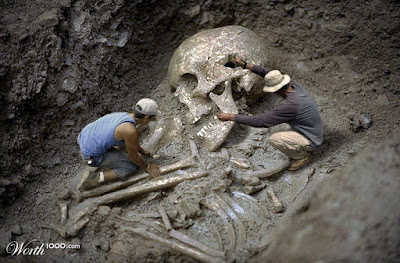
Fifth place entry in Photoshop contest on worth1000.com
"Giant Ancestors" by blackbook (5th place entry in a Photoshop contest on worth1000.com,)
Jews and Christians were scandalized by the thought of “sons of God” mating with mortal women and bearing giant demigod offspring. It is like a tale you would find in Greek mythology of the god Zeus mating with a mortal woman who then gives birth to a great hero like Heracles. Also, the idea of “sons of God” was anathema to monotheistic religions like Judaism or Christianity. So the interpretation took hold that the “sons of God” were actually angels who rebelled against God. Just as we’ve seen with other ancient “interpretations” of difficult biblical passages, there’s nothing in the text to support the idea of a rebellion in heaven. Plus, the idea of half-angelic, half-human offspring doesn’t really solve the “ick” factor.

So another interpretation developed whereby the “sons of God” were interpreted as members in the line descending from Seth, and the “daughters of men” were women descended in the line of Cain. In this interpretation, the offspring would be fully human. The scandal, if any, would be in the “pure” population of the Sethites becoming polluted with the “bad seed” of the Cainites. Again, nothing in the text supports this speculation and it doesn’t explain why children of these unions would be extraordinary warriors or giants.

We have clear evidence from elsewhere in the Bible that the “sons of God” really are divine beings, lesser gods in YHWH’s assembly (Job 1:6; Ps 29:1; Ps 89:7). They were present with YHWH at creation (Job 38:7) and the nations were divided up amongst them (Deut 32:8). The passage really is as scandalous as it appears to be. It recalls an older polytheistic tradition wherein YHWH was one god among many.

But why would the author repeat such a fragment of mythology? Vv. 1-2 and 4 seem to be an origin story of the Nephilim, the heroes of old, the warriors of renown. The author seems to recognize that v. 3 breaks up the flow of thought, because he recapitulates the first two verses in v. 4. V. 3 also appears out of place because YHWH seems to be punishing humans by limiting their lifespan to 120 years although it seems the “sons of God” are the guilty party here, using their power to take advantage of the subordinate mortals. So why isn’t YHWH punishing the divine beings instead?

Biblical scholar Ronald Hendel has a theory that this passage originally served as YHWH’s motivation for sending the Flood. There is a Babylonian flood story called the Atrahasis in which human overpopulation caused so much noise that the god Enlil lost his sleep. His final solution was to send a flood to wipe out all human life, but Atrahasis and his family escaped. Thereafter, death was instituted to prevent a repeat episode. We have allusions to this mythology in Gen 6:1-4 with the references to humans multiplying over the face of the earth and the restriction of human lifespans to (only) 120 years.

According to Hendel’s theory, the original story recounted the creation of demigods, the Nephilim. This creates an imbalance in the cosmos because the divine and mortal realms become intermingled. The solution to this problem was to destroy all living things with a flood in order to restore balance. The Yahwist (J) obscured the causal connection between the creation of the Nephilim and the Flood by providing a different reason for the Flood in vv. 5-7: YHWH saw the evil in humanity and regretted creating human beings, so he will wipe them off the face of the earth. The story of the Nephilim now becomes just one more example of the spread of evil. In J’s version, YHWH’s actions are morally justified because of the wickedness of human beings. Only Noah found favor in the eyes of YHWH.

The only remaining issue to clear up is the fate of the Nephilim. With only Noah and his family surviving the Flood, it seems that “the fallen ones,” true to their name, end up dead. So why are they still around to scare the living daylights out of the scouts Moses sends into Canaan? I guess we have to assume those randy “sons of God” couldn’t keep their hands off our women. As Gen 6:4a specifies, “The Nephilim were on the earth in those days—and also afterward [emphasis mine].” Nothing like a little editorial comment to bring consistency to the story.