Showing posts with label canticle. Show all posts

Wednesday, December 23, 2015

Away in a Manger

The Lucan narrative of the birth of Jesus (Lk 2:1-20) begins with the story of the census that caused Joseph, along with the pregnant Mary, to travel from their hometown of Nazareth to Bethlehem. It continues with Jesus’ birth in a stable and a visit from shepherds. Except for the mention of the angel who had announced Jesus’ birth to Mary, one could start reading Luke’s gospel beginning with chapter 2 and not be aware that anything had been missed.

Census

There are many problems with Luke’s mention of the census. In 1:5, Luke states that Gabriel visited Zechariah in “the days of Herod, king of Judea.” This agrees with Matthew in setting the birth of Jesus during the days of Herod the Great who died in 4 BCE. But in 2:2, Luke dates the census to the time of Quirinius, governor of Syria. Quirinius did conduct a census of Judea, but not until 6-7 CE, so Luke’s dating is off by 10 years. And a census of Judea would not have affected Joseph living in Nazareth, nor was there any requirement that people travel to their ancestral home. Such a requirement would defeat the point of a census, which is to identify the number of people residing in a certain location.

Both Luke and Matthew appear to be trying to deal with contradictory traditions. On the one hand, it was well-known that Jesus came from Nazareth. On the other hand, there was a belief the messiah would be born in Bethlehem. Matthew sees Joseph and Mary as residents of Bethlehem who, after the birth of Jesus, were forced to move to Nazareth for safety reasons. In Luke’s account, the census required Joseph and Mary to travel from Nazareth to Bethlehem so that Jesus could be born there. The Emperor Augustus who issued the edict for the census was an unwitting actor in God’s plan to have a Nazarene born in Bethlehem, thus reconciling the two traditions.

Luke may also have had in mind a passage from the Greek version of Psalm 87:6: “In the census of the peoples, this one will be born there.”

Manger

According to Luke, some time after arriving in Bethlehem (2:6), Mary gave birth to Jesus, swaddled him with strips of cloth and laid him to rest in a manger. The angel appearing to the shepherds repeats this, telling the shepherds this will be the sign of the messiah’s birth (v. 12). And, upon arriving in Bethlehem, they encounter the baby in the manger just as the angel had described (v. 16). Obviously, the manger is a key symbol for Luke.

Adoration of the Shepherds by Bartolome Esteban Murillo (c. 1650)

In the Greek version of Isaiah 1:3, God complains: “The ox knows its owner and the donkey knows the manger of its lord, but Israel has not known me.” When the shepherds arrive and see the baby lying in the manger, their reaction is to begin praising and glorifying God. This is Luke’s way of saying that God’s people have begun to know the manger of their Lord.

According to the traditional King James translation, Mary laid Jesus in a manager “because there was no room for them in the inn.” A modern reader might get the idea of a hotel with no available rooms. But a more accurate translation would be “because there was no place for them in the lodgings.” The word translated as “inn” or “lodgings” would be something like a caravansary or khan. Think of an open-air courtyard where people would stake out an area and set up tents for the night. Given the presence of a manger, a stable is a reasonable surmise for the location of Jesus’ birthplace, but Luke is not interested in that detail.

Gloria

Luke spends the majority of this passage on the annunciation of the angel to the shepherds and their reaction to finding the baby in the manger. In the stereotype of an angelic appearance, we first have the reaction of fear and the assurance, “Be not afraid” (2:10). The angel then announces the birth of the savior in “the city of David” (v. 11). Earlier in v. 4, Bethlehem was called “the city of David.” After the angel departed, the shepherds immediately identified “the city of David” with Bethlehem. The interesting thing about all of this is that, in the OT, Jerusalem is always identified as “the city of David.” If you visit Jerusalem today, you can tour the City of David excavations. Luke intends to shift attention from Jerusalem to Bethlehem because Bethlehem is now where the presence of the Lord resides.

The angel is joined by a heavenly host reciting a very brief canticle (2:14). The traditional King James translation consists of a tricolon:
Glory to God in the highest,
and on earth peace,
good will toward men.
The NRSV, based on more reliable texts, translates as a bicolon:
Glory to God in the highest heaven,
and on earth peace among those whom he favors.
This matches the proclamations of the disciples on Jesus’ entry into Jerusalem (Lk 19:38):
Peace in heaven,
and glory in the highest heaven.
The angels are proclaiming peace on earth and the disciples are proclaiming peace in heaven. Some biblical scholars think the two verses, now separated in the gospel, may have been originally part of the same hymn.

Reactions

After the angelic visitors departed, the shepherds headed for Bethlehem and found the baby lying in the manger. After they described their experience, we see three sets of reactions. All who heard were astonished, but Mary “kept all these things, pondering them in her heart” (2:19 RSV), and the shepherds returned to their fields glorifying and praising God.

Many biblical commentators assume that the shepherds represent the common folk, but with all the references to “the city of David,” it is more likely that Luke is recalling King David who was once a shepherd in the region of Bethlehem. They also, as mentioned above, represent the Israel who now knows the manger of its Lord. The shepherds' response to all they have heard and seen is to praise and glorify God. Just as the heavenly host praised and glorified God in the heavens, now the shepherds do so on earth as well.

The previously unmentioned bystanders who heard the shepherds' story are merely astonished. In the NT, astonishment is a common reaction, but noncommittal in nature.

Mary, on the other hand, recalled these events and sought to interpret them. She is the sole bridge between the events of the infancy narrative and the public ministry of Jesus and the Church. Later in the gospel (8:21) she will appear with the brothers of Jesus as one who hears the word of God and does it. And in Acts (1:14), she will again appear alongside the brothers, disciples and other believers awaiting the day of Pentecost. Luke knew that Mary must have successfully interpreted the events she experienced because she became a model believer. He would have his audience do likewise.

Wednesday, December 9, 2015

Jesus: The Musical

A canticle is a hymn, typically containing a biblical text, that is part of a church service. In the Catholic Church, the Liturgy of the Hours (also known as the Divine Office) reads three canticles from the infancy narrative of Luke each day:
  • Morning: the “Canticle of Zachary” (Lk 1:68-79), commonly called the “Benedictus”
  • Evening: the “Canticle of Mary” (Lk 1:46-55), commonly called the “Magnificat”
  • Night: the “Canticle of Simeon” (Lk 2:29-32), common called the “Nunc Dimittis”
Luke inserted these canticles into an existing pre-Lucan narrative. If you remove them, the narrative flow is not interrupted (for example, Lk 1:80 follows smoothly after 1:66) and you would not know they were missing. Luke did not invent them, however. The style is slightly different in each and, except for a verse or two that Luke probably added, the canticle has nothing to do with the character reciting it or the immediate situation. It’s like watching a Broadway play when a character suddenly breaks into song and then, after the song, everything goes back to normal.

Some scholars believe that Luke’s canticles were originally prayers created by early Jewish Christians, based on verses from the OT. They certainly fit a Jewish hymnic style found in documents dating from 200 BC to 100 CE. If this theory is correct, then these are perhaps the oldest preserved Christian prayers of praise. It is highly appropriate, therefore, that Luke places them on the lips of the first Jewish believers in the good news of salvation realized in the births of John the Baptist and Jesus.

The Benedictus (Lk 1:68-79)

This canticle is spoken by Zechariah, the father of John the Baptist, after the naming of the child. It takes its name from its first words in Latin (Benedictus Dominus Deus Israel, “Blessed be the Lord God of Israel”). In the classification of hymns that is applied to the Psalms, it would best fit the category of a hymn of praise to the God of Israel.

Although the hymn is proclaimed in thanksgiving for the birth of John, it contains mostly messianic references. It is likely that Luke inserted vv. 76-77 to fit the canticle into the context of the birth of John the Baptist:
And you, child, will be called the prophet of the Most High;
for you will go before the Lord to prepare his ways,
to give knowledge of salvation to his people
in the forgiveness of their sins.
In the inserted lines above, it is clear that John is merely the one who goes before the Lord to prepare the way. In the lines prior to this Lucan insertion, the canticle speaks of fulfilling the promises made to David (vv. 68-71) and remembering the oath sworn to Abraham (vv. 72-75). Matthew also wanted to stress that Jesus was a Son of David and a Son of Abraham. These completed actions of salvation are described in the past tense, even though in the context of the narrative, Jesus has not yet been born.
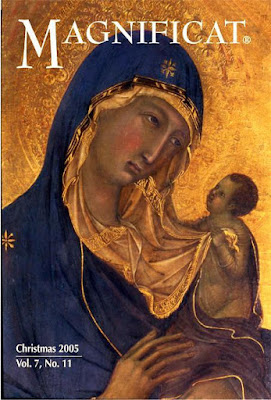
http://www.magnificat.com/
The cover of this issue of the Catholic magazine Magnificat is a detail of the Madonna and Child (c. 1315) by Duccio di Buoninsegna

The Magnificat (Lk 1:46-55)

The Magnificat (Latin for “[my soul] magnifies”) is a canticle spoken by Mary after being praised by Elizabeth, her kinswoman. The opening verse parallels the opening verse of Hannah’s canticle (1 Sam 2:1-2) after the birth of Samuel. Compare:
“My heart is strengthened in the Lord, my horn is exalted in my God…I have rejoiced in thy salvation.” (1 Sam 2:1, LXX)
“My soul magnifies the Lord, and my spirit rejoices in God my Savior.” (Lk 1:46-47, RSV)
The Hannah parallelism continues in the next verse, which is probably a Lucan insertion to the hymn to fit its current context; “Because he has regarded the low estate of his handmaid” echoes 1 Sam 1:11: “O Lord of Hosts, if you will look on the low estate of your handmaid.” In responding to the angel Gabriel a few verses earlier (Lk 1:38), Mary referred to herself as “the handmaid of the Lord.” The word translated handmaid is literally the feminine form of the Greek word for “slave.” Not just poetically beautiful, the word reflects the socioeconomic situation of the first Christians who were predominately found among the slave class.

This theme continues in vv. 51-53 which speaks of casting down the mighty and exalting those of low degree. These verses mirror Hannah’s hymn in 1 Sam 2:7-8 which also speaks of raising up the poor to seat them with the mighty. But more than just recapitulating verses from the OT, the Magnificat also foreshadows the gospel message of the Sermon on the Plain (Luke’s version of Matthew’s Sermon on the Mount) in Lk 6:20-26: “He has filled the hungry with good things, and the rich he has sent away empty.”

Whereas Zechariah praised God for sending the messiah who would fulfill the hopes of Israel, Mary interprets what the sending of the messiah means in concrete terms: strength, exalting the lowly, feeding the hungry.

The Nunc Dimittis (Lk 2:29-32)

When Joseph and Mary presented Jesus in the Temple, an old man named Simeon blessed God in an oracle known as the Nunc Dimittis (from the Latin for “Now you dismiss…”). He also blessed the couple with a second oracle concerning the sign to be contradicted.

The themes and phrasings in the Nunc Dimittis are very reminiscent of various passages from the latter half of Isaiah: seeing salvation (52:9-10), the sight of all the peoples (40:5), a light to the Gentiles (42:6; 49:6), and the glory for Israel (46:13). Having shown believers drawn from observant Jews (Zechariah, Elizabeth, the shepherds, Simeon) thus far in his gospel, Luke now introduces the Gentiles in this passage. The consolation of Israel will be a revelation for the Gentiles.

In Simeon’s second oracle (Lk 2:34-35), he foretells that Jesus will bring about “the fall and rise of many in Israel,” as well as being “a sign to be contradicted,” so that the “inmost thoughts” may be revealed. And in the NT, “inmost thoughts” always has a negative connotation. From Luke’s vantage point, it was clear that many in Israel rejected Jesus and that the future of the good news lies with the Gentiles. It is why he ends Acts of the Apostles with Paul arriving in Rome, his last recorded words stating: “this salvation of God has been sent to the Gentiles; they will listen” (Acts 28:28).

During the season of Advent, the Church relives the stories of Israel and its expectations of a messiah. It is most appropriate, therefore, to reflect on these ancient Jewish Christian hymns redolent with the language of Israel in its praise of God and promises of deliverance.