Showing posts with label Zechariah. Show all posts

Wednesday, December 16, 2015

Hail Mary

The scenes from Luke’s infancy narrative of the Annunciation of Jesus’ Birth to Mary (Lk 1:26-38) and the Visitation of Mary to Elizabeth (Lk 1:39-56) give us one-half of the “Hail Mary” (or Ave Maria) prayer. From 1:28 we get the “Hail Mary, full of grace, the Lord is with thee,” line and from 1:42 we get “Blessed art thou amongst women, and blessed is the fruit of thy womb.” These scenes interrupt the narrative of the announcement and birth of John the Baptist. But they also intersect with that story, as well. Gabriel’s appearance to Mary occurs in the sixth month” (v. 28, 36) of Elizabeth’s pregnancy and led Mary to travel from Galilee to Judea to visit her.

In one of the rare agreements in the infancy narratives of Matthew and Luke, Lk 1:27 describes Mary as “betrothed” (same Greek word used in Mt 1:18) to Joseph, who is of the House of David. As described in my article on the annunciation to Joseph, they were considered married because they had exchanged consent, but they had not begun living together. Unlike Matthew, however, Luke states that Mary was a resident of Nazareth, whereas Matthew has Mary and Joseph living in Bethlehem and only taking up residence in Nazareth after returning from Egypt, deeming Judea unsafe.

Full of Grace

The first Greek word of Gabriel’s greeting to Mary, translated as “hail” in some English versions, is a normal salutation like “hello, good day, greetings.”

The second Greek word is usually translated as “favored one,” or something similar. The Latin Vulgate translated it as “full of grace,” hence the line in the prayer. The root of the word means “grace, favor, charm,” so it’s not entirely out of the ballpark but it’s a bit strong. Luke knew the term and used it in Acts 6:8, but chose not to use it here. In later Catholic theology, the idea took root that Mary was full of all possible graces and led to proclamations of her being free from Original Sin from the moment of her conception (the doctrine of the Immaculate Conception of Mary, not to be confused with the virginal conception of Jesus).

Most scholars are in agreement that the word should be understood as one who has been favored or graced by God. At any rate, Mary was perplexed and wondered what sort of greeting this was (v. 29). Gabriel clarifies by stating, “You have found favor with God” (v. 30). He goes on to explain to the reader that God’s favor is the grace of conceiving “the Son of the Most High” (vv. 31-32). This perfectly fits a translation of “favored one.”
Virgin of the Rocks (1483-86) by Leonardo da Vinci. This earlier of two almost identical versions hangs in the Louvre. (The other version is in London’s National Gallery.) The scene depicts an encounter between the infant John the Baptist and the Madonna and baby Jesus. The angel Uriel points to John the Baptist. Usually, in the iconography of religious art, John points to Jesus.

How Can This Be?

Mary’s response to the angel (“How can this be since I am a virgin?”) in v. 34 has caused consternation and confusion for many. Why would Mary ask Gabriel how she could conceive a child? She’s married to Joseph, but not living with him, so why does she not assume that when she eventually has marital relations she will conceive in the normal way? If you consider the parallel annunciation to Zechariah, after he had completed his priestly service in the Temple, he returned home and afterwards Elizabeth conceived (vv. 23-24). Similarly, in various OT birth annunciations, the conception of the child occurs after the angelic announcement is made. Mary has no reason to think her situation would be different.

A popular theory is that Mary took a vow of virginity. Knowing this, an elderly Joseph agreed to marry her to protect her from other suitors. While this theory gained popularity at a time when men and women regularly took monastic vows, there are no historical precedents in 1st century Judaism. And, as we see elsewhere in Luke (1:25, 48), childlessness in the culture at that time was viewed as a “disgrace.”

A literary explanation looks at other birth announcements in Scripture. At the appearance of the divine messenger, the visionary is told not to be afraid. Then comes the announcement that a woman will give birth to a male child and the name that child is to be called. The visionary then objects that this could happen or asks for a sign and the encounter concludes with the giving of a sign. All of these steps are present in the annunciations to Zechariah and to Mary.

The formula requires an objection in order for the angel to explain to the reader how this is to happen and provide the sign. Zechariah has the objection of age, but Mary’s only objection is that she has not had sexual relations. Her objection allows the angel to spell out that her child will be conceived, not through human agency, but by the Holy Spirit.

Blessed are You Among Women

The sign that Gabriel provides Mary is news that her aged relative Elizabeth is in her sixth month. Mary plays the role of the ideal disciple in Luke by accepting the will of God and then making her way in haste to the hill country of Judea to share the good news. This is a distance of about 90 miles and would have taken 4-5 days to complete on foot.

Playing the part of the prophet he would take later in life, the unborn John stirred in his mother’s womb upon Mary’s arrival. This revealed to Elizabeth the nature of Mary’s condition as mother of the messiah. She then blessed Mary and the unborn Jesus within her. Mary responded with her Magnificat, which has been discussed in another article. She stayed with Elizabeth for three months before returning home, allowing Luke to get her off-the-stage before returning to the conclusion of his narrative of the birth of John the Baptist.

The beginning and end of Elizabeth’s blessing of Mary (vv. 42, 45) are very reminiscent of a scene that only appears in Luke’s gospel (11:27-28). When a woman in the crowd blesses the mother who bore and nursed him, Jesus rejected the importance of biological motherhood: “Blessed rather are those who hear the word of God and obey it.” The OT tells of Jael (Judg 5:24) and Judith (Judith 13:18) who were also considered “blessed among women.” But Jael and Judith were blessed because God used them to deliver Israel through the slaying of an enemy warrior. Mary is blessed because of the fruit of her womb. This, too, recalls a passage from Deuteronomy: “If you fully obey YHWH your God and carefully follow all his commands…the fruit of your womb will be blessed” (Deut 28:1, 4). Elizabeth’s further words (vv. 45) makes clear that it is not only Mary’s physical motherhood that is being praised, but also her faith.

Not only has this passage given us the “Hail Mary” prayer, but it has also been the basis for various Marian doctrines: Mother of God, the Immaculate Conception, Perpetual Virginity, and so on. Luke seems clear that Mary is not to be praised because she was physically the mother of Jesus, but because she meets the criterion of true discipleship.

Wednesday, December 9, 2015

Jesus: The Musical

A canticle is a hymn, typically containing a biblical text, that is part of a church service. In the Catholic Church, the Liturgy of the Hours (also known as the Divine Office) reads three canticles from the infancy narrative of Luke each day:
  • Morning: the “Canticle of Zachary” (Lk 1:68-79), commonly called the “Benedictus”
  • Evening: the “Canticle of Mary” (Lk 1:46-55), commonly called the “Magnificat”
  • Night: the “Canticle of Simeon” (Lk 2:29-32), common called the “Nunc Dimittis”
Luke inserted these canticles into an existing pre-Lucan narrative. If you remove them, the narrative flow is not interrupted (for example, Lk 1:80 follows smoothly after 1:66) and you would not know they were missing. Luke did not invent them, however. The style is slightly different in each and, except for a verse or two that Luke probably added, the canticle has nothing to do with the character reciting it or the immediate situation. It’s like watching a Broadway play when a character suddenly breaks into song and then, after the song, everything goes back to normal.

Some scholars believe that Luke’s canticles were originally prayers created by early Jewish Christians, based on verses from the OT. They certainly fit a Jewish hymnic style found in documents dating from 200 BC to 100 CE. If this theory is correct, then these are perhaps the oldest preserved Christian prayers of praise. It is highly appropriate, therefore, that Luke places them on the lips of the first Jewish believers in the good news of salvation realized in the births of John the Baptist and Jesus.

The Benedictus (Lk 1:68-79)

This canticle is spoken by Zechariah, the father of John the Baptist, after the naming of the child. It takes its name from its first words in Latin (Benedictus Dominus Deus Israel, “Blessed be the Lord God of Israel”). In the classification of hymns that is applied to the Psalms, it would best fit the category of a hymn of praise to the God of Israel.

Although the hymn is proclaimed in thanksgiving for the birth of John, it contains mostly messianic references. It is likely that Luke inserted vv. 76-77 to fit the canticle into the context of the birth of John the Baptist:
And you, child, will be called the prophet of the Most High;
for you will go before the Lord to prepare his ways,
to give knowledge of salvation to his people
in the forgiveness of their sins.
In the inserted lines above, it is clear that John is merely the one who goes before the Lord to prepare the way. In the lines prior to this Lucan insertion, the canticle speaks of fulfilling the promises made to David (vv. 68-71) and remembering the oath sworn to Abraham (vv. 72-75). Matthew also wanted to stress that Jesus was a Son of David and a Son of Abraham. These completed actions of salvation are described in the past tense, even though in the context of the narrative, Jesus has not yet been born.
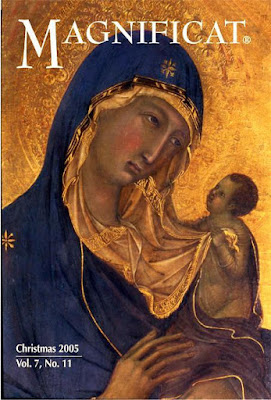
http://www.magnificat.com/
The cover of this issue of the Catholic magazine Magnificat is a detail of the Madonna and Child (c. 1315) by Duccio di Buoninsegna

The Magnificat (Lk 1:46-55)

The Magnificat (Latin for “[my soul] magnifies”) is a canticle spoken by Mary after being praised by Elizabeth, her kinswoman. The opening verse parallels the opening verse of Hannah’s canticle (1 Sam 2:1-2) after the birth of Samuel. Compare:
“My heart is strengthened in the Lord, my horn is exalted in my God…I have rejoiced in thy salvation.” (1 Sam 2:1, LXX)
“My soul magnifies the Lord, and my spirit rejoices in God my Savior.” (Lk 1:46-47, RSV)
The Hannah parallelism continues in the next verse, which is probably a Lucan insertion to the hymn to fit its current context; “Because he has regarded the low estate of his handmaid” echoes 1 Sam 1:11: “O Lord of Hosts, if you will look on the low estate of your handmaid.” In responding to the angel Gabriel a few verses earlier (Lk 1:38), Mary referred to herself as “the handmaid of the Lord.” The word translated handmaid is literally the feminine form of the Greek word for “slave.” Not just poetically beautiful, the word reflects the socioeconomic situation of the first Christians who were predominately found among the slave class.

This theme continues in vv. 51-53 which speaks of casting down the mighty and exalting those of low degree. These verses mirror Hannah’s hymn in 1 Sam 2:7-8 which also speaks of raising up the poor to seat them with the mighty. But more than just recapitulating verses from the OT, the Magnificat also foreshadows the gospel message of the Sermon on the Plain (Luke’s version of Matthew’s Sermon on the Mount) in Lk 6:20-26: “He has filled the hungry with good things, and the rich he has sent away empty.”

Whereas Zechariah praised God for sending the messiah who would fulfill the hopes of Israel, Mary interprets what the sending of the messiah means in concrete terms: strength, exalting the lowly, feeding the hungry.

The Nunc Dimittis (Lk 2:29-32)

When Joseph and Mary presented Jesus in the Temple, an old man named Simeon blessed God in an oracle known as the Nunc Dimittis (from the Latin for “Now you dismiss…”). He also blessed the couple with a second oracle concerning the sign to be contradicted.

The themes and phrasings in the Nunc Dimittis are very reminiscent of various passages from the latter half of Isaiah: seeing salvation (52:9-10), the sight of all the peoples (40:5), a light to the Gentiles (42:6; 49:6), and the glory for Israel (46:13). Having shown believers drawn from observant Jews (Zechariah, Elizabeth, the shepherds, Simeon) thus far in his gospel, Luke now introduces the Gentiles in this passage. The consolation of Israel will be a revelation for the Gentiles.

In Simeon’s second oracle (Lk 2:34-35), he foretells that Jesus will bring about “the fall and rise of many in Israel,” as well as being “a sign to be contradicted,” so that the “inmost thoughts” may be revealed. And in the NT, “inmost thoughts” always has a negative connotation. From Luke’s vantage point, it was clear that many in Israel rejected Jesus and that the future of the good news lies with the Gentiles. It is why he ends Acts of the Apostles with Paul arriving in Rome, his last recorded words stating: “this salvation of God has been sent to the Gentiles; they will listen” (Acts 28:28).

During the season of Advent, the Church relives the stories of Israel and its expectations of a messiah. It is most appropriate, therefore, to reflect on these ancient Jewish Christian hymns redolent with the language of Israel in its praise of God and promises of deliverance.

Wednesday, December 2, 2015

His Name is John

The book of Revelation recounts a vision (4:6-10) of God’s throne room with four creatures resembling a lion, an ox, a man and an eagle. Early Christians took these as symbols of the four evangelists. If we were assigning them today, we might say something like “Matthew emphasizes Jesus as the messianic king, so his symbol should be the lion,” but the early Christians didn’t think like that. Since Matthew’s gospel opens with a genealogy, his symbol would be a man. Mark’s gospel starts in the desert with John the Baptist, so his animal was the lion (because lions were found in the wilderness). John’s gospel begins in heaven, so the eagle became his sign. And the first scene in Luke’s gospel takes place in the sanctuary of the Jerusalem temple, so he was assigned the ox (because oxen were burned as offerings).

Why does Luke begin a gospel about Jesus with an announcement of the birth of John the Baptist in the temple? Like Matthew, Luke felt the need to bridge the gap between the world of the OT and the time of Jesus. Matthew used a genealogy to establish the linkage. Luke took a different route in his first two chapters, bringing OT-like characters in contact with figures from the age of Jesus like Mary. (Luke will do the same at the beginning of his Acts of the Apostles when he needs to transition from the period of Jesus to the age of the Spirit.)

Old Testament Characters

The first scene in Luke’s gospel (1:5-25) takes place as the priest Zechariah is offering incense in the temple. (And Luke will end the gospel with the disciples returning to Jerusalem to pray in the temple.) Zechariah was chosen by lot and this kind of opportunity literally came along once in a lifetime given the number of priests available for such a service. He and his wife Elizabeth are childless and aged. In this respect they are quite similar to Abraham and Sarah in the book of Genesis, the only childless couple in the OT who were incapacitated by age.

They are also reminiscent of Samuel's parents, Hannah and Elkanah. When the barren Hannah paid her annual visit (1 Sam 1:3) to the sanctuary to pray for a child, the priest Eli announced that her prayers would be answered (v. 17). Both Samuel and John are Nazirites from birth, avoiding wine and strong drink (1 Sam 1:11; Lk 1:15). Mary’s Magnificat (1:46-55) is very similar to Hannah’s canticle of praise (1 Sam 2:1-10).

Luke understands that the Hebrew Scriptures are divided into three parts: the Law, the Prophets, and the Writings. Abraham and Sarah are figures from the Law. The story of Samuel and his parents belongs to the Prophets. Lk 1:67 explicitly says that Zechariah, once his muteness was removed, uttered a prophecy. The angel’s pronouncement of John’s future career in 1:17 alludes to Malachi, the last of the prophetic writings (Mal 3:1; 3:23-24; some translations 4:5-6).

That brings us to the figure of the angel Gabriel. The only time that Gabriel appears in the OT is in Daniel. Each time Gabriel appears to Daniel (Dan 9-10), it is called a “vision,” just as his appearance is called in Luke. Zechariah, like Daniel before him (Dan 9:20-21), was offering up prayers when he had his vision and, like Daniel (Dan 10:15), was struck mute. In the Hebrew Scriptures, the book of Daniel appears in the portion called the Writings – unlike the Christian OT where it is grouped with the Prophets.

The Naming of John

In an allusive fashion, Luke has spanned the entirety of the OT with the cast and settings of his first chapter. In Luke’s mind, John is the hinge between the age of the Law and the Prophets and the time of Jesus: “The Law and the Prophets were until John; since then the Kingdom of God is preached” (Lk 16:16). John is described in the infancy narrative as an Elijah-like figure who will go before the Lord and be filled with the Spirit, terms that are applied to him later when Luke describes his ministry.

The similarities with OT stories do not end after the announcement of John’s birth. After being struck mute, Zechariah returned home and Elizabeth conceived (1:23-24); compare this with “Then they went to their home…and in due time Hannah conceived” (1 San 1:19-20). Elizabeth’s reaction of “The Lord has dealt with me in this way,” (v. 25) echoes Hannah, “The Lord remembered her.” Elizabeth’s feeling that her pregnancy has taken away her “disgrace” is reminiscent of Rachel’s reaction upon giving birth to Joseph: “God has taken away my disgrace” (Gen 30:23).
An aged Elizabeth looks on as Zechariah writes down his wish for the name of the baby. The Birth of St. John the Baptist by Giuliano Bugiardini (1475-1555)
The story of the annunciation to Mary (1:26-56) interrupts John’s nativity story; we’ll discuss that in a separate article. The actual birth is described briefly in vv. 57-58. Luke spends more time (vv. 59-66) on the naming of John with emphasis on the “miracle” that both Zechariah and Elizabeth independently came up with the same name. We would naturally assume that the two had discussed a name during the pregnancy, even if they had to pass notes back and forth due to Zechariah’s muteness – and apparent deafness. When the muteness is lifted, Zechariah delivers his praise of God (vv. 67-79); we’ll discuss the Benedictus in a later article as well.

The final verse of the story (1:80) sets up the bridge for John’s public ministry: “The child grew and became strong in spirit, and he was in the desert until the day of his public appearance to Israel.” The next time we hear of John is 3:2b and it picks up the thread: “the word of God came to John the son of Zechariah in the desert.”

John Goes Before Jesus

But why bother to tell the story of John’s birth at all? Luke appears to be following the gospel tradition of introducing John the Baptist before Jesus. As odd as it sounds to us, the Baptist was better known in the 1st century CE than Jesus was. The Jewish historian Josephus, for example, writes twice as much about John’s ministry and death as he does about Jesus (and even that much includes later Christian embellishment). It seems natural that the gospel writers would introduce Jesus’ public ministry by describing how the better-known figure of John the Baptist essentially passed the torch to him. But John has ever since been overshadowed by Jesus and is now known mostly as a minor character in the gospel drama.

In the Catholic Church, John’s birth is celebrated on June 24. Maybe it is coincidental that the Nativity of John the Baptist occurs right after the summer solstice – as the days start getting shorter – just as Christmas occurs right after the winter solstice – as the days start getting longer. Whether intentional or not, the symbolism is inescapable when you recall what the Gospel of John said about the Baptist: “He himself was not the light, but he came to testify to the light” (Jn 1:8). And later in the gospel, the Baptist himself testified about Jesus: “He must increase, but I must decrease” (Jn 3:30).