Showing posts with label gospel. Show all posts

Tuesday, January 5, 2016

Lost and Found

It is said that “nature abhors a vacuum.” The same can be said for would-be biographers of Jesus. The earliest gospel – that of Mark – begins the story of Jesus with his baptism by John. Since then, there has always been a curiosity among Christians to know what happened in the life of Jesus during those “hidden years” before his public ministry. In fact, a whole genre of literature called “hidden life” stories sprang up to describe what happened to Jesus in the years between his birth and his public ministry.

“Hidden Life” Tales

The purpose of “hidden life” stories – not only of Jesus, but of other great men in history – is to illustrate how the seeds of the adult’s success are to be found in the child. A familiar example to Americans is the story of George Washington, originated by Parson Weems, in which the young George admits to his father that he cut down the cherry tree:“I cannot tell a lie.” The tales of Jesus’ hidden life illustrate how, even as a child, he came to reveal his true nature in his own words and actions, unlike in the infancy narratives where the revelation had to happen through an intermediary.

The best-known of the hidden life stories of Jesus is the Infancy Gospel of Thomas. It recounts anecdotes of the boy Jesus from age 5 to age 12. The anecdotes of the very young Jesus portray him as a brat using his powers in a punitive fashion to blind or maim those that annoy him, but as he ages he begins healing and raising people from the dead. He also performs miracles that help his own family such as stretching a beam of wood to fit a bed Joseph was building. Interwoven through these miracles are attempts by various teachers to instruct the young Jesus, resulting in Jesus doing the teaching. The last anecdote in the apocryphal gospel is based on Luke’s account of finding of Jesus in the Temple (Lk 2:41-52).

“You are going to be so grounded when we get home.” Jesus Found in the Temple by James Tissot (1836-1902)

Some scholars believe that the miracle of turning water into wine at the wedding in Cana (John 2:1-11) is another example of a hidden life story that found its way into a canonical gospel. This is the only miracle story in the NT that involves the mother of Jesus. In a hypothetical “hidden life” anecdote, Mary would have asked Jesus to supply wine and he would have given instructions on what to do, just as he instructed Joseph on how to address the problem of the short beam in the Infancy Gospel of Thomas. If such is the case, John thoroughly rewrote the material to change the hidden life “gift miracle” anecdote into a “sign” of Jesus’ glory (“sign” and “work” being John’s preferred designations instead of “miracle”).

Luke’s Gospel version 2.0

Many biblical scholars believe that Luke originally intended to end his infancy narrative with the return of the Holy Family to Nazareth after fulfilling their duties in the Temple (Lk 2:39-40). Luke employs the literary device of an inclusio by beginning the infancy narrative in the Temple and ending it in the Temple. Similarly with his characters, Luke began with the elderly couple of Zechariah and Elizabeth and brought it full circle with the elderly couple of Simeon and Anna. He parallels the announcement, birth and prophecy of the future career of John the Baptist with the announcement, birth and prophecy of the future career of Jesus. Vv. 39-40 wrap up the infancy narrative and prepare the reader for the adult Jesus presenting himself to John for baptism.

That nice symmetry is broken with the insertion of the story of finding the boy Jesus in the Temple. This passage also introduces some inconsistencies with what went before (more on that later). It does not assume the reader is familiar with anything that happened previously in Luke’s gospel, and in fact is more intelligible if one reads it as an independent story. Yet, it has Lucan language throughout, so if the story was part of the tradition that Luke received, he reworked the material to fit it into his gospel, reprising the transitional verses about Mary keeping the events in her heart (compare Lk 2:51c with 2:19) and Jesus growing in wisdom (compare Lk 2:52 with 2:40).

In My Father’s House

The story itself is straightforward. Being an observant Jewish family, Mary and Joseph traveled to Jerusalem every year to celebrate Passover. When Jesus was twelve, unbeknownst to his parents he stayed behind in Jerusalem. Thinking he was with relatives or friends, they went a day’s journey from Jerusalem before realizing he was not with the traveling party. Returning to Jerusalem, they found him three days later (presumably, one day out, one day back, one day searching) in the Temple precincts, sitting with the “teachers” – not “scribes” or “lawyers” – listening and asking questions.

Luke says simply, “And all who heard him were amazed at his understanding and his answers” (2:47 NRSV). The Infancy Gospel of Thomas, however, gilds the lily somewhat in its version: “And those listening to him were amazed how he questioned the elders and explained the main points of the law and the riddles and the parables of the prophets.” In the apocryphal gospel, Jesus can’t simply listen and ask questions, he has to explicate the law and prophets.

Now comes the climax of the story. Mary chides Jesus for causing them worry and Jesus responds that it is only natural he should be in his Father’s house. Luke says that his parents did not understand what he said to them (2:50). Given that earlier in the gospel Gabriel explicitly tells Mary that Jesus “will be called Son of God” (1:35), why would his parents not understand when he says he says the Temple is his Father’s house? It doesn’t make sense in the context of Luke’s gospel where we have already been told the messianic secret, but does make sense if this was once an independent story meant to introduce the gospel message that Jesus is the son of God.

Having introduced this self-revelation on Jesus’ part, Luke now has a problem. It was well-established in the gospels that no one knew Jesus’ true identity during his ministry. Even his disciples did not really understand it until after his resurrection. But if Jesus knew who he was even as a boy, why did no one know who he was as an adult? Luke’s solution is to make this a one-off event and send him back to Nazareth with his parents where he would be obedient to them (2:51). He’s the mild-mannered Clark Kent growing up in Smallville, hiding from the world the secret that he is really Superman.

Wednesday, December 30, 2015

Our Lady of Sorrows

In the story of the census (Lk 2:1-5), Luke intends to demonstrate that Joseph and Mary – and by extension all Christians – are obedient to Roman law. In the story of the presentation in the Temple (2:22-40), Luke intends to show that Joseph and Mary were also faithful observers of Jewish law as well. The brief verse 2:21 on the circumcision and naming of Jesus is a hinge verse that could either conclude the birth narrative (2:1-20) or introduce the presentation narrative.

Hannah and the Presentation of Samuel

To understand the background of Luke’s scene of the presentation of Jesus in the Temple, we have to return again to the story of Hannah in the OT (1 Samuel 1:1-2:11). As we have seen previously, Hannah was the favored, but childless, wife of Elkanah. On a visit to YHWH’s sanctuary at Shiloh, Hannah promised that if she were to bear a male child, she would dedicate him to God as a nazirite. Seeing Hannah praying in the sanctuary, the aged priest Eli assured her that her prayer would be answered. After Samuel was weaned, Hannah took him to the sanctuary and presented him to Eli, and Samuel remained in service to YHWH.

Luke presents a version of that OT scene, but confuses two different customs: the purification of the mother and the presentation of the firstborn male child. Leviticus (12:1-10) specifies that, following birth, a woman is ritually unclean for forty days, after which time she shall present at the sanctuary the offering of two young pigeons or doves (see Lk 2:24). Exodus (13:11-15) demands the consecration of all firstborn sons, but Numbers (18:15-16) allows the firstborn to be redeemed from service to YHWH for five shekels. Bringing the child to the sanctuary is not a requirement.

Just as Luke employed the census to bring Joseph and Mary from Nazareth to Bethlehem, he now utilizes the purification ceremony to bring the couple to Jerusalem. This allows him to end the infancy narrative in the Jerusalem Temple, just as he began the infancy narrative in the Temple with Gabriel’s annunciation to Zechariah. Since Jesus is being redeemed and not dedicated, there is no need to present him in the Temple, but Luke wants to parallel the story of Hannah presenting Samuel to Eli, with the aged Simeon standing in for the priest Eli.

Simeon and the Oracle of the Pierced Soul

Simeon is described in OT terms: “upright and devout and waiting for the consolation of Israel.” He is also described as something of a prophet, so Luke is joining the themes of Law (purification of the mother, presentation of the firstborn) and the Prophets. Simeon takes the child Jesus in his arms and utters two prophetic oracles. We have previously discussed the first oracle (Lk 2:29-32), the Nunc Dimittis, as well as the second oracle (Lk 2:34-35) foretelling that Jesus will bring about division.

In Catholic iconography, the Virgin Mary is frequently portrayed with a sword through her heart. This represents Simeon's prophecy in Luke 2:35 that a sword will pierce her soul.
The most obscure part of Simeon’s second oracle is the parenthetical line addressed to Mary: “indeed, a sword will pass through your own soul.” The most common interpretation of the sword piercing the soul is the pain of sorrow that Mary will experience as she stands at the foot of the cross and witnesses the death of her son. The problem with this interpretation is that the scene of Mary at the foot of the cross comes from the Gospel of John (19:25-27), not Luke. Since a verse from Luke should not require a completely different gospel for interpretation, we should look within Luke’s gospel to explain the verse.

First, some background on the imagery. The closest OT parallel is Ezekiel 14:17 wherein the sword is one of the judgments – the others being famine, wild beasts, and plague – God will send to punish the land; some will die but others will live. So it is not just a punishment, but a discriminating judgment. What Luke seems to be trying to say is that the sword of division will also affect Mary; she must choose if she will accept or reject Jesus.

There is one scene in the public ministry where Mary appears in all three synoptic gospels. This is the scene where Mary and the brothers of Jesus come to him. In the Marcan form of this (Mk 3:31-35), his family comes out of concern that Jesus is “out of his mind” (Mk 3:21). Because his family fails to understand his mission, Jesus rejects his family. He asks rhetorically, “Who are my mother and my brothers?” before looking at the crowd around him, saying, “Here are my mother and my brothers.” In the Lucan version (8:19-21), the rhetorical question and gesturing to the crowd are eliminated, leaving only Jesus’ proclamation, “My mother and my brothers are those who hear the word of God and do it.” In Luke’s gospel, Mary and his brothers are part of Jesus’ family not merely because of a biological connection, but because of their response to the gospel.

Unlike Mark who has a negative view of the immediate family of Jesus, Luke sees them as model believers and shows them as part of the early Church awaiting the spirit on Pentecost (Acts 1:14).

Anna and the Return to Nazareth

The elderly prophetess Anna is mentioned only briefly. Perhaps Luke wanted both her and Simeon in the Temple at the end of his story to balance the aged Zechariah and Elizabeth at the beginning of his story. Or, perhaps he didn’t want to end the infancy narrative on the foreboding note of Simeon’s second oracle.

For someone so briefly mentioned that not even her dialogue is quoted, Luke provides curious detail in her biographical note, providing the name of her father and her tribe. V. 37 either describes her as having been a widow for 84 years, or states that she is a widow of 84 years of age. If the former, she would have to be around 103 years old. While that sounds ridiculous, it would be reminiscent of the heroine Judith, a widow who lived to be 105 (Judith 16:22-23). Widows seemed to have a special role in the early church (1 Tim 5:3-10).

Vv. 39-40 bring the infancy narrative to a close as Joseph and Mary return to Nazareth, the child growing up, filled with wisdom and favored by God. These last lines recall the ending of the story of Samuel (1 Sam 2:20-21) in which Elkanah and Hannah returned to their home after presenting Samuel to Eli and the boy Samuel grew in the presence of YHWH. Luke is preparing the reader for the appearance of the adult Jesus of Nazareth, preaching a message of wisdom and exemplifying God’s favor.

Wednesday, December 16, 2015

Hail Mary

The scenes from Luke’s infancy narrative of the Annunciation of Jesus’ Birth to Mary (Lk 1:26-38) and the Visitation of Mary to Elizabeth (Lk 1:39-56) give us one-half of the “Hail Mary” (or Ave Maria) prayer. From 1:28 we get the “Hail Mary, full of grace, the Lord is with thee,” line and from 1:42 we get “Blessed art thou amongst women, and blessed is the fruit of thy womb.” These scenes interrupt the narrative of the announcement and birth of John the Baptist. But they also intersect with that story, as well. Gabriel’s appearance to Mary occurs in the sixth month” (v. 28, 36) of Elizabeth’s pregnancy and led Mary to travel from Galilee to Judea to visit her.

In one of the rare agreements in the infancy narratives of Matthew and Luke, Lk 1:27 describes Mary as “betrothed” (same Greek word used in Mt 1:18) to Joseph, who is of the House of David. As described in my article on the annunciation to Joseph, they were considered married because they had exchanged consent, but they had not begun living together. Unlike Matthew, however, Luke states that Mary was a resident of Nazareth, whereas Matthew has Mary and Joseph living in Bethlehem and only taking up residence in Nazareth after returning from Egypt, deeming Judea unsafe.

Full of Grace

The first Greek word of Gabriel’s greeting to Mary, translated as “hail” in some English versions, is a normal salutation like “hello, good day, greetings.”

The second Greek word is usually translated as “favored one,” or something similar. The Latin Vulgate translated it as “full of grace,” hence the line in the prayer. The root of the word means “grace, favor, charm,” so it’s not entirely out of the ballpark but it’s a bit strong. Luke knew the term and used it in Acts 6:8, but chose not to use it here. In later Catholic theology, the idea took root that Mary was full of all possible graces and led to proclamations of her being free from Original Sin from the moment of her conception (the doctrine of the Immaculate Conception of Mary, not to be confused with the virginal conception of Jesus).

Most scholars are in agreement that the word should be understood as one who has been favored or graced by God. At any rate, Mary was perplexed and wondered what sort of greeting this was (v. 29). Gabriel clarifies by stating, “You have found favor with God” (v. 30). He goes on to explain to the reader that God’s favor is the grace of conceiving “the Son of the Most High” (vv. 31-32). This perfectly fits a translation of “favored one.”
Virgin of the Rocks (1483-86) by Leonardo da Vinci. This earlier of two almost identical versions hangs in the Louvre. (The other version is in London’s National Gallery.) The scene depicts an encounter between the infant John the Baptist and the Madonna and baby Jesus. The angel Uriel points to John the Baptist. Usually, in the iconography of religious art, John points to Jesus.

How Can This Be?

Mary’s response to the angel (“How can this be since I am a virgin?”) in v. 34 has caused consternation and confusion for many. Why would Mary ask Gabriel how she could conceive a child? She’s married to Joseph, but not living with him, so why does she not assume that when she eventually has marital relations she will conceive in the normal way? If you consider the parallel annunciation to Zechariah, after he had completed his priestly service in the Temple, he returned home and afterwards Elizabeth conceived (vv. 23-24). Similarly, in various OT birth annunciations, the conception of the child occurs after the angelic announcement is made. Mary has no reason to think her situation would be different.

A popular theory is that Mary took a vow of virginity. Knowing this, an elderly Joseph agreed to marry her to protect her from other suitors. While this theory gained popularity at a time when men and women regularly took monastic vows, there are no historical precedents in 1st century Judaism. And, as we see elsewhere in Luke (1:25, 48), childlessness in the culture at that time was viewed as a “disgrace.”

A literary explanation looks at other birth announcements in Scripture. At the appearance of the divine messenger, the visionary is told not to be afraid. Then comes the announcement that a woman will give birth to a male child and the name that child is to be called. The visionary then objects that this could happen or asks for a sign and the encounter concludes with the giving of a sign. All of these steps are present in the annunciations to Zechariah and to Mary.

The formula requires an objection in order for the angel to explain to the reader how this is to happen and provide the sign. Zechariah has the objection of age, but Mary’s only objection is that she has not had sexual relations. Her objection allows the angel to spell out that her child will be conceived, not through human agency, but by the Holy Spirit.

Blessed are You Among Women

The sign that Gabriel provides Mary is news that her aged relative Elizabeth is in her sixth month. Mary plays the role of the ideal disciple in Luke by accepting the will of God and then making her way in haste to the hill country of Judea to share the good news. This is a distance of about 90 miles and would have taken 4-5 days to complete on foot.

Playing the part of the prophet he would take later in life, the unborn John stirred in his mother’s womb upon Mary’s arrival. This revealed to Elizabeth the nature of Mary’s condition as mother of the messiah. She then blessed Mary and the unborn Jesus within her. Mary responded with her Magnificat, which has been discussed in another article. She stayed with Elizabeth for three months before returning home, allowing Luke to get her off-the-stage before returning to the conclusion of his narrative of the birth of John the Baptist.

The beginning and end of Elizabeth’s blessing of Mary (vv. 42, 45) are very reminiscent of a scene that only appears in Luke’s gospel (11:27-28). When a woman in the crowd blesses the mother who bore and nursed him, Jesus rejected the importance of biological motherhood: “Blessed rather are those who hear the word of God and obey it.” The OT tells of Jael (Judg 5:24) and Judith (Judith 13:18) who were also considered “blessed among women.” But Jael and Judith were blessed because God used them to deliver Israel through the slaying of an enemy warrior. Mary is blessed because of the fruit of her womb. This, too, recalls a passage from Deuteronomy: “If you fully obey YHWH your God and carefully follow all his commands…the fruit of your womb will be blessed” (Deut 28:1, 4). Elizabeth’s further words (vv. 45) makes clear that it is not only Mary’s physical motherhood that is being praised, but also her faith.

Not only has this passage given us the “Hail Mary” prayer, but it has also been the basis for various Marian doctrines: Mother of God, the Immaculate Conception, Perpetual Virginity, and so on. Luke seems clear that Mary is not to be praised because she was physically the mother of Jesus, but because she meets the criterion of true discipleship.

Wednesday, December 9, 2015

Jesus: The Musical

A canticle is a hymn, typically containing a biblical text, that is part of a church service. In the Catholic Church, the Liturgy of the Hours (also known as the Divine Office) reads three canticles from the infancy narrative of Luke each day:
  • Morning: the “Canticle of Zachary” (Lk 1:68-79), commonly called the “Benedictus”
  • Evening: the “Canticle of Mary” (Lk 1:46-55), commonly called the “Magnificat”
  • Night: the “Canticle of Simeon” (Lk 2:29-32), common called the “Nunc Dimittis”
Luke inserted these canticles into an existing pre-Lucan narrative. If you remove them, the narrative flow is not interrupted (for example, Lk 1:80 follows smoothly after 1:66) and you would not know they were missing. Luke did not invent them, however. The style is slightly different in each and, except for a verse or two that Luke probably added, the canticle has nothing to do with the character reciting it or the immediate situation. It’s like watching a Broadway play when a character suddenly breaks into song and then, after the song, everything goes back to normal.

Some scholars believe that Luke’s canticles were originally prayers created by early Jewish Christians, based on verses from the OT. They certainly fit a Jewish hymnic style found in documents dating from 200 BC to 100 CE. If this theory is correct, then these are perhaps the oldest preserved Christian prayers of praise. It is highly appropriate, therefore, that Luke places them on the lips of the first Jewish believers in the good news of salvation realized in the births of John the Baptist and Jesus.

The Benedictus (Lk 1:68-79)

This canticle is spoken by Zechariah, the father of John the Baptist, after the naming of the child. It takes its name from its first words in Latin (Benedictus Dominus Deus Israel, “Blessed be the Lord God of Israel”). In the classification of hymns that is applied to the Psalms, it would best fit the category of a hymn of praise to the God of Israel.

Although the hymn is proclaimed in thanksgiving for the birth of John, it contains mostly messianic references. It is likely that Luke inserted vv. 76-77 to fit the canticle into the context of the birth of John the Baptist:
And you, child, will be called the prophet of the Most High;
for you will go before the Lord to prepare his ways,
to give knowledge of salvation to his people
in the forgiveness of their sins.
In the inserted lines above, it is clear that John is merely the one who goes before the Lord to prepare the way. In the lines prior to this Lucan insertion, the canticle speaks of fulfilling the promises made to David (vv. 68-71) and remembering the oath sworn to Abraham (vv. 72-75). Matthew also wanted to stress that Jesus was a Son of David and a Son of Abraham. These completed actions of salvation are described in the past tense, even though in the context of the narrative, Jesus has not yet been born.
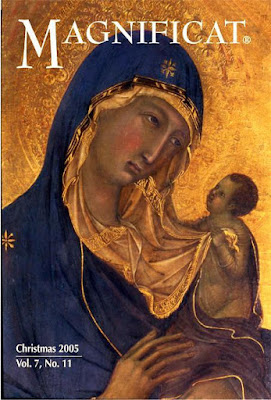
http://www.magnificat.com/
The cover of this issue of the Catholic magazine Magnificat is a detail of the Madonna and Child (c. 1315) by Duccio di Buoninsegna

The Magnificat (Lk 1:46-55)

The Magnificat (Latin for “[my soul] magnifies”) is a canticle spoken by Mary after being praised by Elizabeth, her kinswoman. The opening verse parallels the opening verse of Hannah’s canticle (1 Sam 2:1-2) after the birth of Samuel. Compare:
“My heart is strengthened in the Lord, my horn is exalted in my God…I have rejoiced in thy salvation.” (1 Sam 2:1, LXX)
“My soul magnifies the Lord, and my spirit rejoices in God my Savior.” (Lk 1:46-47, RSV)
The Hannah parallelism continues in the next verse, which is probably a Lucan insertion to the hymn to fit its current context; “Because he has regarded the low estate of his handmaid” echoes 1 Sam 1:11: “O Lord of Hosts, if you will look on the low estate of your handmaid.” In responding to the angel Gabriel a few verses earlier (Lk 1:38), Mary referred to herself as “the handmaid of the Lord.” The word translated handmaid is literally the feminine form of the Greek word for “slave.” Not just poetically beautiful, the word reflects the socioeconomic situation of the first Christians who were predominately found among the slave class.

This theme continues in vv. 51-53 which speaks of casting down the mighty and exalting those of low degree. These verses mirror Hannah’s hymn in 1 Sam 2:7-8 which also speaks of raising up the poor to seat them with the mighty. But more than just recapitulating verses from the OT, the Magnificat also foreshadows the gospel message of the Sermon on the Plain (Luke’s version of Matthew’s Sermon on the Mount) in Lk 6:20-26: “He has filled the hungry with good things, and the rich he has sent away empty.”

Whereas Zechariah praised God for sending the messiah who would fulfill the hopes of Israel, Mary interprets what the sending of the messiah means in concrete terms: strength, exalting the lowly, feeding the hungry.

The Nunc Dimittis (Lk 2:29-32)

When Joseph and Mary presented Jesus in the Temple, an old man named Simeon blessed God in an oracle known as the Nunc Dimittis (from the Latin for “Now you dismiss…”). He also blessed the couple with a second oracle concerning the sign to be contradicted.

The themes and phrasings in the Nunc Dimittis are very reminiscent of various passages from the latter half of Isaiah: seeing salvation (52:9-10), the sight of all the peoples (40:5), a light to the Gentiles (42:6; 49:6), and the glory for Israel (46:13). Having shown believers drawn from observant Jews (Zechariah, Elizabeth, the shepherds, Simeon) thus far in his gospel, Luke now introduces the Gentiles in this passage. The consolation of Israel will be a revelation for the Gentiles.

In Simeon’s second oracle (Lk 2:34-35), he foretells that Jesus will bring about “the fall and rise of many in Israel,” as well as being “a sign to be contradicted,” so that the “inmost thoughts” may be revealed. And in the NT, “inmost thoughts” always has a negative connotation. From Luke’s vantage point, it was clear that many in Israel rejected Jesus and that the future of the good news lies with the Gentiles. It is why he ends Acts of the Apostles with Paul arriving in Rome, his last recorded words stating: “this salvation of God has been sent to the Gentiles; they will listen” (Acts 28:28).

During the season of Advent, the Church relives the stories of Israel and its expectations of a messiah. It is most appropriate, therefore, to reflect on these ancient Jewish Christian hymns redolent with the language of Israel in its praise of God and promises of deliverance.

Wednesday, December 2, 2015

His Name is John

The book of Revelation recounts a vision (4:6-10) of God’s throne room with four creatures resembling a lion, an ox, a man and an eagle. Early Christians took these as symbols of the four evangelists. If we were assigning them today, we might say something like “Matthew emphasizes Jesus as the messianic king, so his symbol should be the lion,” but the early Christians didn’t think like that. Since Matthew’s gospel opens with a genealogy, his symbol would be a man. Mark’s gospel starts in the desert with John the Baptist, so his animal was the lion (because lions were found in the wilderness). John’s gospel begins in heaven, so the eagle became his sign. And the first scene in Luke’s gospel takes place in the sanctuary of the Jerusalem temple, so he was assigned the ox (because oxen were burned as offerings).

Why does Luke begin a gospel about Jesus with an announcement of the birth of John the Baptist in the temple? Like Matthew, Luke felt the need to bridge the gap between the world of the OT and the time of Jesus. Matthew used a genealogy to establish the linkage. Luke took a different route in his first two chapters, bringing OT-like characters in contact with figures from the age of Jesus like Mary. (Luke will do the same at the beginning of his Acts of the Apostles when he needs to transition from the period of Jesus to the age of the Spirit.)

Old Testament Characters

The first scene in Luke’s gospel (1:5-25) takes place as the priest Zechariah is offering incense in the temple. (And Luke will end the gospel with the disciples returning to Jerusalem to pray in the temple.) Zechariah was chosen by lot and this kind of opportunity literally came along once in a lifetime given the number of priests available for such a service. He and his wife Elizabeth are childless and aged. In this respect they are quite similar to Abraham and Sarah in the book of Genesis, the only childless couple in the OT who were incapacitated by age.

They are also reminiscent of Samuel's parents, Hannah and Elkanah. When the barren Hannah paid her annual visit (1 Sam 1:3) to the sanctuary to pray for a child, the priest Eli announced that her prayers would be answered (v. 17). Both Samuel and John are Nazirites from birth, avoiding wine and strong drink (1 Sam 1:11; Lk 1:15). Mary’s Magnificat (1:46-55) is very similar to Hannah’s canticle of praise (1 Sam 2:1-10).

Luke understands that the Hebrew Scriptures are divided into three parts: the Law, the Prophets, and the Writings. Abraham and Sarah are figures from the Law. The story of Samuel and his parents belongs to the Prophets. Lk 1:67 explicitly says that Zechariah, once his muteness was removed, uttered a prophecy. The angel’s pronouncement of John’s future career in 1:17 alludes to Malachi, the last of the prophetic writings (Mal 3:1; 3:23-24; some translations 4:5-6).

That brings us to the figure of the angel Gabriel. The only time that Gabriel appears in the OT is in Daniel. Each time Gabriel appears to Daniel (Dan 9-10), it is called a “vision,” just as his appearance is called in Luke. Zechariah, like Daniel before him (Dan 9:20-21), was offering up prayers when he had his vision and, like Daniel (Dan 10:15), was struck mute. In the Hebrew Scriptures, the book of Daniel appears in the portion called the Writings – unlike the Christian OT where it is grouped with the Prophets.

The Naming of John

In an allusive fashion, Luke has spanned the entirety of the OT with the cast and settings of his first chapter. In Luke’s mind, John is the hinge between the age of the Law and the Prophets and the time of Jesus: “The Law and the Prophets were until John; since then the Kingdom of God is preached” (Lk 16:16). John is described in the infancy narrative as an Elijah-like figure who will go before the Lord and be filled with the Spirit, terms that are applied to him later when Luke describes his ministry.

The similarities with OT stories do not end after the announcement of John’s birth. After being struck mute, Zechariah returned home and Elizabeth conceived (1:23-24); compare this with “Then they went to their home…and in due time Hannah conceived” (1 San 1:19-20). Elizabeth’s reaction of “The Lord has dealt with me in this way,” (v. 25) echoes Hannah, “The Lord remembered her.” Elizabeth’s feeling that her pregnancy has taken away her “disgrace” is reminiscent of Rachel’s reaction upon giving birth to Joseph: “God has taken away my disgrace” (Gen 30:23).
An aged Elizabeth looks on as Zechariah writes down his wish for the name of the baby. The Birth of St. John the Baptist by Giuliano Bugiardini (1475-1555)
The story of the annunciation to Mary (1:26-56) interrupts John’s nativity story; we’ll discuss that in a separate article. The actual birth is described briefly in vv. 57-58. Luke spends more time (vv. 59-66) on the naming of John with emphasis on the “miracle” that both Zechariah and Elizabeth independently came up with the same name. We would naturally assume that the two had discussed a name during the pregnancy, even if they had to pass notes back and forth due to Zechariah’s muteness – and apparent deafness. When the muteness is lifted, Zechariah delivers his praise of God (vv. 67-79); we’ll discuss the Benedictus in a later article as well.

The final verse of the story (1:80) sets up the bridge for John’s public ministry: “The child grew and became strong in spirit, and he was in the desert until the day of his public appearance to Israel.” The next time we hear of John is 3:2b and it picks up the thread: “the word of God came to John the son of Zechariah in the desert.”

John Goes Before Jesus

But why bother to tell the story of John’s birth at all? Luke appears to be following the gospel tradition of introducing John the Baptist before Jesus. As odd as it sounds to us, the Baptist was better known in the 1st century CE than Jesus was. The Jewish historian Josephus, for example, writes twice as much about John’s ministry and death as he does about Jesus (and even that much includes later Christian embellishment). It seems natural that the gospel writers would introduce Jesus’ public ministry by describing how the better-known figure of John the Baptist essentially passed the torch to him. But John has ever since been overshadowed by Jesus and is now known mostly as a minor character in the gospel drama.

In the Catholic Church, John’s birth is celebrated on June 24. Maybe it is coincidental that the Nativity of John the Baptist occurs right after the summer solstice – as the days start getting shorter – just as Christmas occurs right after the winter solstice – as the days start getting longer. Whether intentional or not, the symbolism is inescapable when you recall what the Gospel of John said about the Baptist: “He himself was not the light, but he came to testify to the light” (Jn 1:8). And later in the gospel, the Baptist himself testified about Jesus: “He must increase, but I must decrease” (Jn 3:30).

Friday, November 27, 2015

Samson the Nazorean?

One aspect of Matthew’s style is to quote a passage from the OT prefixed with words to the effect: “All this took place to fulfill what the Lord had spoken by the prophet who said...” Matthew does this more than any of the other evangelists, some 10 to 14 times (depending on what qualifies as a citation). In most cases, it breaks up the narrative flow and the passage reads better without the citation.

Almost certainly, these OT quotes were added by Matthew and were not part of the tradition he received. For example, Mark 1:14 records the beginning of Jesus’ ministry in Galilee after John the Baptist’s arrest. This verse is paralleled in Luke 4:14, also without a Scripture citation. But when Matthew records the same incident in his gospel at 4:12-16, he states this was done to fulfill what Isaiah prophesied in Is 8:23-9:1 (9:1-2 in some translations).

In a previous article, I covered Mt 1:22-23, the first of his 10-14 fulfillment citations. Mt 2 offers three or maybe four more prophetic citations. Let me briefly discuss each one.

1. From you will come forth a ruler who will shepherd my people (2:6)

This is an oddball passage. First, it does cite the OT but lacks the “all this took place to fulfill…” formula. This is one of those cases scholars are not sure should count as a prophetic fulfillment.

Second, the citation references two separate verses from the OT:
  • “But you, O Bethlehem Ephrathah, who are little to be among the clans of Judah, from you shall come forth for me one who is to be ruler in Israel.” (Micah 5:1; 5:2 in some translations)
  • “You shall be shepherd of my people Israel” (2 Samuel 5:2)
Matthew made some minor changes like replacing Ephrathah with “land of Judah” for the better understanding of his readers, but nothing substantial.

This passage is one piece of evidence that there was an expectation in the 1st century CE that the messiah would be born in Bethlehem. John 7:41-42 provides independent evidence of the same expectation. Matthew and Luke wrote their infancy narratives in part to affirm that Jesus was in fact born in Bethlehem, although he was better-known as a resident of Nazareth. 

2. Out of Egypt I have called my son (2:15b)

An almost verbatim citation of Hosea 11:1. The only thing worth mentioning is that the “son” in the original is a reference to Israel and its exodus from Egypt. Matthew, like his contemporaries, was not overly concerned with interpreting a verse in its original context. 

3. Rachel crying for her children (2:18)

Again, we have a fairly accurate citation of Jeremiah 31:15. In the original context, Jeremiah is possibly referring to Judah’s defeat by the Babylonians; Ramah was a staging point for the deportations from Jerusalem (Jer 40:1). Also, in the original context, the figurative Rachel is being told to stop weeping because her children will return from the enemy’s land (vv. 16-17). There is no such hope in Matthew’s situation.

4. He will be called a Nazorean (2:23b)

The evangelists use the terms “Jesus the Nazarane” and “Jesus the Nazorean” interchangeably. Matthew, however, only uses the Nazorean form. And he only uses it here at the beginning of his gospel and again towards the end (26:71).

This is the oddest fulfillment citation yet because there is no clear OT verse that Matthew is citing. Did Matthew just make it up? The best guesses for his OT sources are:
  • “He will be called holy.” (Isaiah 4:3)
  • “I have been a Nazirite of God.” (Judges 16:17)
Now, if those two OT verses don’t seem anything at all like Matthew’s citation, you’re not alone. This will require a bit of explanation.

Nazirite comes from the Hebrew word nazir, meaning “set apart as sacred.” (It should definitely not be confused with the German Nazi Party!) The Nazirite vow is explained in Numbers 6:1-21 and involves abstaining from the products of grapes, cutting of the hair, and contact with the dead. The vow was usually taken for a short period of time, but there were some (like Samson and Samuel) who were life-long Nazirites. The quote above from Judges is Samson’s statement to Delilah as to why he does not cut his hair.
World’s worst haircut. Samson was a Nazirite and Matthew saw this as foretelling Jesus would be a Nazorean? Victor Mature and Hedy Lamarr (inventor of spread-spectrum technologies) in Cecil B. DeMille’s Samson and Delilah.

When this verse was translated into Greek, some manuscripts took a literal approach and translated nazir as Naziraios, while other manuscripts freely translated it as hagios (“holy one”). Keeping in mind the interchangeability in the Greek versions of hagios/Naziraios, when Matthew looked at Is 4:3, he could read it as “He will be called a Naziraios.” This is very close to what Matthew wrote down: “He will be called a Nazoraios.” 

Essentially, Matthew is getting a two-fer as the word Nazoraios both describes Jesus as coming from Nazareth, and it also depicts him as the “Holy One of God.” Some explanation of Jesus coming from Nazareth was necessary because, unlike Bethlehem, Nazareth is never mentioned in the OT at all. If the prophets foresaw the virginal conception, birth in Bethlehem, the massacre of the innocents, and the flight into Egypt, then they must certainly have foretold that Jesus would come from Nazareth. The “Holy One of God” title is a very unusual one for Jesus, appearing only in Mark 1:24; Luke 4:34; and John 6:69.

This convoluted way of interpreting Scripture was common in Matthew’s day. It was based on the idea that all of Scripture had God as the one author and spoke with one voice, although in many accents. As a scribe, Matthew would see himself as discerning a pattern in the Scriptures that pointed to God’s plan for the birth and ministry of his Son.

Wednesday, November 25, 2015

An Epiphany of Sorts

The word epiphany comes from the Greek word meaning “appearance” or “manifestation.” In the Church calendar, the feast of Epiphany is traditionally celebrated on January 6 in commemoration of the coming of the magi to the Christ Child and marks the end of the 12 days of Christmas. Called “Three Kings Day” in some countries, the festival celebrates the first manifestation of Christ to the Gentiles. In conversational usage, “epiphany” means a sudden flash of understanding or insight through a simple or commonplace experience.

Visit of the Astrologers

Mt 2:1-23 provides the story of the visit of the magi, the flight to Egypt and the massacre of the innocent. The evangelist jumps straight from Joseph naming Jesus after his birth in 1:25 to the magi arriving in Jerusalem in 2:1. The magi, or wise men, were most likely astrologers, not kings. Matthew doesn’t say how many there were or their point of origin other than that they were “from the east.” The popular idea that there were three wise men is based on the three gifts the magi brought: gold, frankincense and myrrh. Later traditions (from the 6th century CE) provide them with names such as Melchior, Gaspar, and Balthasar, different ethnicities and ages (old man with a white beard, young beardless man, and man with black skin).
The Adoration of the Magi, tapestry (designed by Edward Burne-Jones 1888, woven 1894)
Noting the rising of a particular star, the magi determined that it signified the birth of the “king of the Jews.” Thus, it was observations of the natural world that led the Gentile astrologers to the messiah. But, the natural world reveals only so much; the magi must inquire of King Herod the Great in Jerusalem as to the exact location of the child. God’s revelation in Scripture is needed for them to complete their journey.

Herod calls together his “chief priests and scribes” – the same antagonists that the adult Jesus will face in his ministry – and is told that Bethlehem is the birth place based on Micah 5:2. Although Herod and his scribes have the Scriptures, they do not believe and hence cannot use that information themselves. Herod learns the exact time of the star’s appearance – presumably the date of the child’s birth – from the magi and asks them to report back to him once they have found the newborn king.

The magi set out towards Bethlehem and the star led them to the exact location (2:9). Many have speculated if the “star” was a supernova, comet, or planetary conjunction. None of these could be used to pinpoint a particular house in Bethlehem. And it is a house in Bethlehem, according to v. 11. In Matthew’s telling, Mary and Joseph were residents of Bethlehem.

About those gifts...Matthew is not explicitly citing Isaiah, but may have him in mind: “all those from Sheba shall come bearing gold and frankincense and proclaiming the salvation of the Lord” (Is 60:6, LXX). We’re all familiar with gold. Frankincense was usually burnt as incense in religious ceremonies. Myrrh, an aromatic spice, was used as incense, as perfume, and as a cosmetic. Mixed with wine, it was offered as a painkiller to Jesus on the cross (Mark 15:23) and, with aloes, was used to embalm Jesus (John 19:39). Certainly, they were gifts befitting a king.

Refugees in Egypt

After the magi failed to return to Herod, he ordered the death of all boys two years of age or younger in the vicinity of Bethlehem. If the population of Bethlehem was about 1000, the number would be less than 20 boys. There are no records of Herod ordering this, but he was notoriously paranoid and it sounds like something he could have done. Matthew tells us that Herod decided on two years based on the time of the star’s first appearance (v. 16). The clues in the story tell us that Jesus would have been one or two years old, not the newborn babe in the traditional nativity story.

Joseph was warned of the danger by an angel in a dream and told to take his family and flee to Egypt until further notice. Only after the death of Herod (in 4 BCE) does the angel re-appear to Joseph in a dream and instruct him to return to Israel “for those who were seeking the child’s life are dead” (v. 20). This is a clear echo of Exodus 4:19 when Moses is told the same thing while he is an exile in Midian.

Joseph planned to return to Bethlehem until he learned that Herod’s son Archelaus was ruling over Judea. An angel had to instruct Joseph in one more dream that he should go instead to Galilee, whereupon he made his home in Nazareth. Why didn’t the angel simply tell Joseph in one dream to go directly to Galilee from Egypt? The awkwardness probably stems from Matthew adding vv. 22-23 to material that he inherited. Matthew is taking pains to explain to his audience how Jesus could have been born in Bethlehem – because that’s was Joseph’s home – yet was known to have come from Nazareth. (Luke uses the census to explain how Joseph and Mary, residents of Nazareth, found themselves in Bethlehem for Jesus’ birth.)

Mosaic Pattern

The imagery in Matthew’s narrative is reminiscent of stories surrounding Moses. It is not mentioned in the OT, but the Jewish historian Josephus, writing around the time of Matthew (80-90 CE), told the story of an Egyptian pharaoh who was informed by one of his fortune-tellers that a child born of the Israelites would be the downfall of the Egyptians. This caused the pharaoh to order the deaths of the male babies. But Moses’ father Amram was visited by God in a dream and told that his unborn child would be the one feared in the Egyptian prophecy. Later, as an adult, Moses fled to Midian to save his life, only returning to Egypt once he was told that those seeking his life were dead.

Much later still, when Moses was leading the Israelites to the promised land, Balak the king of Moab, called upon Balaam, a practitioner of the magical arts (the NT would call him a magus), to curse Israel (Numbers 22-24). Instead of cursing the Israelites, Balaam blessed them, predicting that “a star shall rise out of Jacob and a scepter shall come forth from Israel” (Num 24:17). This was understood as referring to the Davidic monarchy, but later was re-interpreted as a prophecy of a messianic king in the line of David.

Gospel in Miniature

Having reviewed Mt 1-2, we can see why the infancy narrative is called “a gospel in miniature.” In these two short chapters, Matthew explains various christological titles ascribed to Jesus: Christ, Son of Abraham, Son of David, Son of God, and King of the Jews. He also shows the reactions to this revelation, both good (the magi) and bad (Herod). Despite having the guide of the Scriptures, Herod (representing the Jews) rejects the messiah and tries to kill him, but he is accepted and paid homage by the magi (representing the Gentiles). This reflects the situation in Matthew’s community, which is predominantly Gentile. Although his opponents tried to kill Jesus, God protected him and later brought him back.

Studying the infancy narrative here and in Luke more than 30 years ago, was sort of an epiphany for me. I began to see that the imagery and symbolism had layers of meaning far deeper than I could have imagined. They were no longer background stories for nativity plays and Christmas specials. Understanding their true purpose helped me put the adult Christ back into Christmas.

Thursday, November 5, 2015

The Apostles Go to the Movies

Before starting a discussion on the infancy narratives, how about some “gospel truths” for background?
  1. Mark is the oldest gospel (written around 66-70 CE). Mark begins his gospel with the baptism of Jesus by John the Baptist. Mark never mentions the name of Jesus’ legal father, Joseph.
  2. Matthew and Luke used Mark as a basis for their own gospels (80-90 CE), but added additional material not found in Mark. Some of the supplementary material in Matthew has parallels with additions in Luke, but some non-Marcan material is only found in Matthew or only found in Luke.
  3. Because so much of the material in Matthew, Mark and Luke are similar, they are called the synoptic gospels.
  4. John’s gospel (90-100 CE) is very different and not based on Mark. Outside of the passion narrative, there are very few points of contact with the synoptic gospels. After a brief prologue on how the divine Word existed before creation and became flesh, John’s gospel opens with Jesus’ baptism. 
  5. The infancy narrative in Matthew appears in the first two chapters and contains material that is exclusive to Matthew.
  6. The infancy narrative in Luke appears in the first two chapters and contains material that is exclusive to Luke.
This brief survey highlights the peculiar nature of the infancy narratives. They seem to be prefixed to the gospels of Matthew and Luke like the prologue of a novel. The prologue sets the stage for what is to come, but you could skip it and not have missed anything crucial to the plot. There are no references in the rest of Matthew and Luke to anything that occurs in the infancy narratives.

Unlike the narratives and sayings from the public ministry which have the authority of the disciples standing behind it, there were few witnesses to the events being described in the infancy narratives. Theoretically, Matthew or Luke could have spoken to people who were alive during the time of Jesus’ ministry, but it is highly unlikely that any family members privy to the events of Jesus’ birth would have still been alive when Matthew and Luke wrote their gospels. And, if so, why are the stories so different?

While the two infancy narratives are completely distinct, there are a few points of agreement between them that may indicate a core of common tradition:
  • Mary conceives after she has been betrothed to Joseph but before they live together.
  • The conception of the child is through the Holy Spirit.
  • Joseph is of Davidic descent.
  • An angel announces the birth of the child, that he is to be named Jesus, and that he is to be Savior.
  • The birth takes place after the parents have come to live together.
  • The birth takes place in Bethlehem but the child is reared in Nazareth.
  • The birth occurs during the reign of Herod the Great.

There are other infancy narratives in works that never became accepted as part of the NT (that is, non-canonical gospels), but these date from a later period (2nd century CE) than the four canonical gospels and seem to have been influenced by them, so they do not provide us with any independent information. Our only source of knowledge of the infancy of Jesus (such as it is) are in the first two chapters of Matthew and Luke.

So why do Matthew and Luke each provide an infancy narrative while Mark and John are unconcerned about the early life of Jesus? Let’s look back at the “gospel truths” above. The one main point of contact among all four canonical gospels is the passion narrative (#4). This suggests that the story of Jesus’ death and resurrection was the most primitive core of early Christian preaching. 

Stories and sayings from Jesus’ public ministry became attached to the passion narratives. Mark was the first to do this (#1 above) and there may have been a collection of sayings from which Matthew and Luke both drew (#2). For Mark, the baptism of Jesus is when God reveals who Jesus is and marks the start of his ministry. This is a critical moment in all four canonical gospels. 

But for Matthew and Luke it wasn’t enough. Jesus couldn’t have become God’s son only at his baptism. By prefixing the infancy narratives to their gospels, Matthew and Luke showed that Jesus was the Son of God from his conception and birth. The evangelists are not merely relating biographical information; they are making a proclamation of the good news of salvation.

In Talladega Nights, Ricky Bobby (played by Will Ferrell) liked the Christmas Jesus best: “When you say grace, you can say it to grown-up Jesus, or teenage Jesus, or bearded Jesus, or whatever you want.”
It’s like one of those movies with a big twist (for example, The Sixth Sense, Fight Club, The Usual Suspects) that cause you to re-evaluate everything you thought was going on in the movie. The director provides you with a series of brief flashbacks so you can see how previous scenes now need to be understood.

For the early disciples of Jesus, the resurrection event was that twist. They thought Jesus was going to bring about his new kingdom, only to have their hopes dashed to pieces by his crucifixion. But the resurrection appearances caused them to re-evaluate the events around Jesus’ death. That, in turn, caused them to interpret the sayings and works of his ministry in a new light. Eventually, this train of thought led to the angel’s proclamation of Jesus as savior in the infancy narratives. 

The understanding of who Jesus was worked its way backwards from his resurrection to his baptism by John to his conception and birth. The adult Christ is very much a part of the infancy narrative.

Or, as Ricky Bobby in Talladega Nights would say, “Dear eight-pound, six-ounce newborn infant Jesus, don’t even know a word yet, just a little infant and so cuddly, but still omnipotent.”