Monday, September 14, 2015

Review of Darren Aronofsky's "Noah"

Noah, a major motion picture directed by Darren Aronofsky, was released in 2014. I only recently watched the film and, for the most part, I enjoyed it. Starring Russell Crowe as Noah, it isn’t a typical biblical epic of the Cecil B. DeMille variety with cheesy effects, melodramatic acting, and overwrought dialogue. Just like DeMille’s epics, it embellishes the source material, but it is true to the spirit, if not the letter, of the biblical text. It follows in the tradition of Jewish midrash, which sought to fill in gaps in the biblical narrative, sometimes in fanciful ways. (Warning: Spoilers ahead!)

Russell Crowe stars as Noah
For example, one of the more interesting novelties in the movie is that of the Watchers. To provide manpower for ark construction, Noah enlists the aid of fallen angels whose bodies of light have become trapped within rock. Not surprisingly, Noah’s construction project and the mass migrations of thousands of animals have attracted the attention of Noah’s ruthless contemporaries and when the rain starts to fall and the mob tries to take the ark, the Watchers are instrumental in repelling the invaders.
"Noah" is sort of a mashup of "The Lord of the Rings" and "Mad Max"
I’m sure for many in the audience, this seems to be taking great liberties with the Bible, but the myth of the Watchers is well-known to those who have studied the inter-testamental literature – that is, the various non-biblical books written between the time of the OT and the NT – especially, the Book of Enoch. The Watchers were the “sons of God” who both taught humans the arts of mining and metallurgy and also mated with the “daughters of men” to give birth to the “giants” (or Nephilim). 

Fundamentalists, of course, have problems with the movie not being true to the letter of Scripture. One creationist review complains that the movie wasn’t historically accurate because it didn’t show Noah bringing dinosaurs on board the Ark. Seriously. Others have problems with the symbolism used in the movie. Christian theologian Brian Mattson calls it a pagan retelling of the flood story based on teachings from Kabbalah (Jewish mysticism) and Gnosticism (a heretic form of Christianity), two incompatible philosophies that he seems to conflate. Peter Chattaway at patheos.com wrote an article clarifying that “No, Noah is not Gnostic” (the actual title of his article). 

Another complaint of evangelical critics is that God did not speak to Noah in a clear and unambiguous fashion as he does in the Bible. “The Creator” (never called “God” in the movie) only revealed his plan to Noah in the form of a dream of a drowned world. But after coming in close contact with the brutal humans who overrun the antediluvian world, Noah decides that the Creator only wants to preserve the innocent animals and accepts that humanity is fated to die with him and his family after they live out their natural lives. Clearly, if the Creator had laid it out for Noah as God does in the Bible, the last part of the movie would have been less suspenseful.

But in real life, we’re not always sure what God’s will is. The Noah portrayed in the movie certainly wanted to follow the will of “the Creator” and thought he understood that will. But when Shem’s previously barren wife becomes pregnant with twin girls aboard ship, Noah decides that carrying out the Creator’s wishes will require him to slay the babies because they will grow up to bear children of their own. When Noah’s love for his family prevents him from doing that, he sees himself as a failure. It falls to his daughter-in-law to explain that the Creator chose him because Noah could see the good and evil in people and know if there was enough good left in humanity to make it worth saving.

Part of the reason evangelicals do not like the movie is that Noah is considered something of a saint in Christian theology. The Bible points out on multiple occasions (Gen 6:22; 7:5, 9, 16) that Noah did all that God commanded him, God established a covenant with him, Noah was considered a “righteous man” and so on. In the NT the flood was seen as a sort of extreme baptism (see 1 Peter 3:20-21), destroying the old world of sin out of which a new world would be born, and Noah was the instrument for salvation.

But Jews don’t see Noah the same way. One of the new insights that I discovered in preparing this review was in an interview by The Times of Israel with “America’s rabbi” Shmuley Boteach. Rabbi Boteach points out why the biblical Noah is not considered a hero in Jewish tradition:
He [Noah] failed in the greatest mission of all. He failed to protect human life. And failed to fight with God when he wanted to take human life. He refuses to wrestle with God. Noah is a fundamentalist. He’s a religious extremist. God says “everyone will die” and Noah says nothing. But this is not what God wants. God wants people with moxie! God wants people with spiritual audacity! He does not want the obedient man of belief. He wants the defiant man of faith.
The rabbi points out, by way of contrast, that when Abraham was told that YHWH planned to destroy Sodom, Abraham didn’t just nod his head and say, “Thy will be done.” Instead, he interceded on behalf of Sodom (Gen 18-22-33), forcing YHWH to agree to spare the city if only 10 righteous people could be found in it. “This made him the first Jew. A Jew does not just accept a divine decree, he does not just bow his head in silent obedience.”

In the final analysis, Noah portrays a religious man who will go to extremes to follow what he believes is the Creator’s will. His obsession will either guarantee the salvation of life on earth or result in the extermination of the human race. The outcome rests on his humanity.

Wednesday, September 9, 2015

P, R and J Sandwich

The familiar Christmas story is taken from the first two chapters of Matthew and Luke. The magi, the slaughter of the innocents, and the flight into Egypt all come from Matthew. The census, birth in a stable, and shepherds all come from Luke. These individual elements from the two distinct infancy narratives fit well together in the traditional nativity story and it would be hard to identify them if we didn’t have the original narratives in Matthew and Luke.

We have a similar situation with the flood story in Genesis 6-9. Here we have elements from two different narratives – one from J and one from P – that were woven together by a redactor (“R” for short; redactor being another name for editor). Bible scholars can ascribe the verses to J or P based on the use of the divine name, themes, vocabulary or narrative style. Unlike the creation stories and genealogies where R left the J and P narratives stand on their own, in the flood narrative R used P as the main storyline and supplemented it with J at appropriate points. Sometimes R alternates several verses between J and P, but at other times he interweaves his source material. 

For example, R provides parallel accounts for the decision to destroy humanity. J’s account is in 6:5-8 and P’s version is in vv. 11-12. J emphasizes that YHWH is sorry that he had made humans. P repeatedly uses the word “corrupt” to emphasize his point: “Now the earth was corrupt in God’s sight, and the earth was filled with violence. And God saw that the earth was corrupt; for all flesh had corrupted its ways upon the earth.” 
“Building Noah’s Ark” by Franzosischer Meister (“The French Master”), 1675
These passages are followed by instructions for the building of the ark (vv. 13-22) taken from the P account. Similar instructions must have existed in J’s account, but R left them out. P delights in specifications for the length and width and height of the ark, along with the number of floors, window and door. The familiar command to bring aboard the ark “two of each kind” of bird, animal, and creeping thing recalls the similar enumeration of animals in P’s creation story in Genesis 1.

R returns to J’s narrative with the commission to enter the Ark in 7:1-5. Noah is instructed to bring a pair of unclean animals, but seven pairs of clean animals. “Clean” and “unclean” refers to whether the animals in questions are considered suitable for sacrifice. You would expect that the Priestly writer would be more concerned about ritually “clean” vs. “unclean” animals, but for P those categories did not exist until Moses was given the Law on Sinai. J’s rationale for having Noah bring aboard seven pairs of clean animals is to allow for their use in a sacrifice to YHWH after the flood (8:20-21).

With the description of the coming of the flood in 7:6-24, R repeatedly switches back and forth between P and J, sometimes in the middle of the same sentence. Here is what J’s portion of this passage would look like:
And Noah went into the ark to escape the waters of the flood and YHWH shut him in. The rain fell on the earth forty days and forty nights. And the waters increased, and bore up the ark, and it rose high above the earth. He blotted out every living thing that was on the face of the ground. Everything on dry land in whose nostrils was the breath of life died. Only Noah was left, and those that were with him in the ark.
In J’s account, YHWH personally seals Noah and his family into the ark. The flood is brought about by rain for forty days and nights. The reference to blotting out all creatures “in whose nostrils was the breath of life” recalls how YHWH breathed life into the earth creature in J’s creation account (Gen 2:7).

P’s narrative in the remainder of 7:6-24 illustrates his style of providing exact dates (“In the six hundredth year of Noah’s life, in the second month, on the seventeenth day of the month”) and numbers (“fifteen cubits deep”). P’s flood is not just a very long rain, but a return to the chaos prior to creation as windows in the firmament are opened to allow the upper waters to pour down and the lower waters below the earth are allowed to erupt. Unlike J’s forty days, P’s flood lasted for 150 days and took an equivalent amount of time for the waters to recede. The earth was dry (that is, the flood over) on the first day of the first month (8:13). Just as Gen 1 provided the context for the Sabbath observance, the flood story provides the context for the New Year’s festival because God is creating the world anew.

The ark soon came to rest on “the mountains of Ararat” (“Ararat” is a region, not a specific mountain). In the J account (8:6-12) Noah experiments with birds to discern when it is safe to exit the ark, but in the P account (8:15-19) God simply tells Noah when it is time to disembark. This is followed by J’s report of Noah’s thanksgiving sacrifice and YHWH’s promise not to again destroy the earth (20-22). The parallel passage from P narrates God’s renewed blessing of Noah (9:1-7) and his covenant to never again destroy the earth with a flood (8-17).
Sandwich structure of the flood narrative
In this article I focused on the separate J and P traditions so you could see the distinctiveness of each. But we also have to look at the complete text as it came down to us from R. There is artistry here. R did not simply grab bits and pieces from each tradition and insert them willy-nilly, but chose them to fit a chiastic pattern (or “sandwich” structure) with “God remembered Noah” at the center. It is not that God had forgotten about Noah; “remember” in this context means refers to God’s mercy towards one in danger of death (see Gen 19:29). It is the pivotal moment of the story because from here on, God’s attention is on reversing the destructive actions of the flood.

The flood story itself is pivotal in that it separates the primeval events “before the flood” from historical events “after the flood.” The world following the flood is the world in which we live.

Tuesday, September 1, 2015

How the Mighty Have Fallen

In my very first article on this blog, I wrote: “I hope to shed light on obscure or downright weird passages in the Bible that make people scratch their heads.” Well, I think that description definitely applies to Gen 6:1-4. It is short enough to quote in its entirety:
When men began to multiply on the face of the ground, and daughters were born to them, the sons of God saw that the daughters of men were fair; and they took to wife such of them as they chose. Then the Lord said, “My spirit shall not abide in man forever, for he is flesh, but his days shall be a hundred and twenty years.” The Nephilim were on the earth in those days, and also afterward, when the sons of God came in to the daughters of men, and they bore children to them. These were the mighty men that were of old, the men of renown. (RSV)
The KJV translates Nephilim as “giants” due to the report in Num 13:33 describing the original inhabitants of Canaan: “All the people that we saw in it are of great size. There we saw the Nephilim … and to ourselves we seemed like grasshoppers, and so we seemed to them.” Nephilim means “the fallen ones,” the ones fallen in death, because every time the Nephilim – or similar names like the Anakim or Rephaim – are mentioned in the Bible, it is only to explain how one of the great heroes (like Moses or Joshua or David) wiped them out.
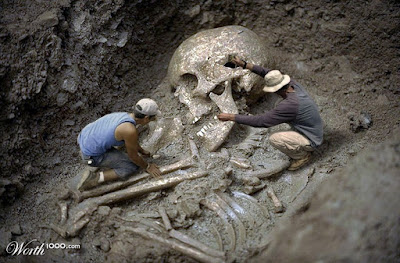
Fifth place entry in Photoshop contest on worth1000.com
"Giant Ancestors" by blackbook (5th place entry in a Photoshop contest on worth1000.com,)
Jews and Christians were scandalized by the thought of “sons of God” mating with mortal women and bearing giant demigod offspring. It is like a tale you would find in Greek mythology of the god Zeus mating with a mortal woman who then gives birth to a great hero like Heracles. Also, the idea of “sons of God” was anathema to monotheistic religions like Judaism or Christianity. So the interpretation took hold that the “sons of God” were actually angels who rebelled against God. Just as we’ve seen with other ancient “interpretations” of difficult biblical passages, there’s nothing in the text to support the idea of a rebellion in heaven. Plus, the idea of half-angelic, half-human offspring doesn’t really solve the “ick” factor.

So another interpretation developed whereby the “sons of God” were interpreted as members in the line descending from Seth, and the “daughters of men” were women descended in the line of Cain. In this interpretation, the offspring would be fully human. The scandal, if any, would be in the “pure” population of the Sethites becoming polluted with the “bad seed” of the Cainites. Again, nothing in the text supports this speculation and it doesn’t explain why children of these unions would be extraordinary warriors or giants.

We have clear evidence from elsewhere in the Bible that the “sons of God” really are divine beings, lesser gods in YHWH’s assembly (Job 1:6; Ps 29:1; Ps 89:7). They were present with YHWH at creation (Job 38:7) and the nations were divided up amongst them (Deut 32:8). The passage really is as scandalous as it appears to be. It recalls an older polytheistic tradition wherein YHWH was one god among many.

But why would the author repeat such a fragment of mythology? Vv. 1-2 and 4 seem to be an origin story of the Nephilim, the heroes of old, the warriors of renown. The author seems to recognize that v. 3 breaks up the flow of thought, because he recapitulates the first two verses in v. 4. V. 3 also appears out of place because YHWH seems to be punishing humans by limiting their lifespan to 120 years although it seems the “sons of God” are the guilty party here, using their power to take advantage of the subordinate mortals. So why isn’t YHWH punishing the divine beings instead?

Biblical scholar Ronald Hendel has a theory that this passage originally served as YHWH’s motivation for sending the Flood. There is a Babylonian flood story called the Atrahasis in which human overpopulation caused so much noise that the god Enlil lost his sleep. His final solution was to send a flood to wipe out all human life, but Atrahasis and his family escaped. Thereafter, death was instituted to prevent a repeat episode. We have allusions to this mythology in Gen 6:1-4 with the references to humans multiplying over the face of the earth and the restriction of human lifespans to (only) 120 years.

According to Hendel’s theory, the original story recounted the creation of demigods, the Nephilim. This creates an imbalance in the cosmos because the divine and mortal realms become intermingled. The solution to this problem was to destroy all living things with a flood in order to restore balance. The Yahwist (J) obscured the causal connection between the creation of the Nephilim and the Flood by providing a different reason for the Flood in vv. 5-7: YHWH saw the evil in humanity and regretted creating human beings, so he will wipe them off the face of the earth. The story of the Nephilim now becomes just one more example of the spread of evil. In J’s version, YHWH’s actions are morally justified because of the wickedness of human beings. Only Noah found favor in the eyes of YHWH.

The only remaining issue to clear up is the fate of the Nephilim. With only Noah and his family surviving the Flood, it seems that “the fallen ones,” true to their name, end up dead. So why are they still around to scare the living daylights out of the scouts Moses sends into Canaan? I guess we have to assume those randy “sons of God” couldn’t keep their hands off our women. As Gen 6:4a specifies, “The Nephilim were on the earth in those days—and also afterward [emphasis mine].” Nothing like a little editorial comment to bring consistency to the story.

Tuesday, August 25, 2015

Begin the Begats

There is much in the story of Cain and Abel to perplex a casual reader of the Bible. First, when YHWH sentences Cain to exile in the land of Nod, Cain complains in Gen 4:14c, “Anyone who meets me may kill me!” According to the story, there is no one else in the world beside his mother and father, so why should Cain fear that he will be hunted down and killed? A couple of verses later, in 4:17, we read that Cain “knew his wife,” she bore him a son (Enoch), and he built a city which he named after his son. Where did his wife come from? And how could there be enough people in the world, let alone the “land of Nod,” that a city would be needed to hold them all?

Based on clues like these, biblical scholars speculate that the story of Cain and Abel was once an independent story that was attached to the story of Adam and Eve. The story of Cain and Abel presupposes that there were more people in the world than just Adam and Eve and their two sons. Unless there were neighbors around to witness the deed, why else would Cain be concerned about taking Abel out into the field to kill him? And why else would he be concerned about his safety when he was expelled from the community? It also explains how he was able to find a wife and need to build a city.

There’s another clue in the genealogies in Gen 4 and 5. Gen 4:17-24 gives a list of Cain’s descendants: Enoch, Irad, Mehujael, Methusahael, Lamech. The closing verses list the three sons of Lamech: Jabal, Jubal and Tubal-cain (and one daughter, Naamah). Vv. 25-26 describe the birth of Seth to replace Abel, and the birth of Seth’s son, Enosh (which means “man” in Hebrew).
The Cain Family tree according to Gen 4:17-24

Gen 5:1-32 begins with Adam begetting Seth and proceeds to Enosh, Kenan, Mahalalel, Jared, Enoch, Methuselah, Lamech, and Noah. Noah, it is noted, had three sons: Shem, Ham and Japheth. The name of the Seth line is eerily similar to the Cain line. Both genealogies end with the naming of 3 sons instead of the usual one. Biblical scholars believe that we have two traditions citing the line of descent from Adam, one through Cain and one through Seth.

The writing styles differ, too. The genealogy in Gen 5 follows a strict formula, just like the creation story in Gen 1 followed a strict formula. Biblical scholars attribute Gen 1 and 5 to the “Priestly” writer (or “P”) because of his interest in priestly matters like legal codes, genealogies and rituals. The genealogy in Gen 5 cites the name of the father, states he was X number of years old when he begat his first son, he lived Y number of years after that, and then after living X+Y years, he died. This formula is not broken except for Enoch who, instead of dying, was “taken by God.” If we only read Gen 5, we would have no indication that Cain, rather than Seth, was Adam’s firstborn son.

Compare this to the genealogy in 4:17-26 and it is a bit more free-form. We get details about the various accomplishments of the individuals mentioned: Cain built the first city, Lamech took two wives, Jabal was the ancestor of tent-dwellers, Jubal of musicians, and Tubal-cain of blacksmiths. A couple of wives and a daughter are also named. This genealogy is showing us how civilization and technology spread in the primeval period. Also, violence as Lamech brags about how he takes extreme vengeance on any who slights him in the least way. Lamech’s story prepares us for the increasing amount of sinfulness in the world that will lead God to want to destroy it in a great flood. Scholars attribute the author of this genealogy in Gen 4 (along with Gen 2-3) to the “Yahwist” writer (or “J”), who gets his name from his consistent use of the name YHWH for God.

Another difference between the two is that J’s genealogy does not provide ages for the various ancestors. P’s genealogy provides precise numbers and, using those numbers and others like them, we could calculate a date around 4000 BCE for the creation of the world. The problem for chronologists is that the numbers of years separating Adam from Noah are different depending on whether you consult the Hebrew Masoretic Text (1656 years), the Greek Septuagint (2242) or the Samaritan Pentateuch (1307). It quickly becomes apparent that the ages were not in the original text, but were added later.

It is also apparent that there is a desired number each tradition is aiming for and the ages are adjusted to meet that pre-determined date. One proposal, for example, is that the total of the years from the creation of earth to the dedication of the second temple in Jerusalem is 3600 according to the MT. When you consider that the Bible was edited during the Babylonian Captivity and the Babylonians used a base-60 mathematical system, 3600 is 60 x 60, a nice round symbolic number in base-60. Perhaps the numbers are different in the SP because they were counting to founding of the Samaritan temple on Mount Gerizim. We don’t really know for sure, other than that the numbers were definitely manipulated for some symbolic purpose.

The genealogies are considered by many to be some of the “boring” parts of the Bible, but there are some interesting aspects to them. Once you know where to look.

Wednesday, August 19, 2015

Demon at the Door

Chapters 1-11 of Genesis, recounting events from the creation of the cosmos to the Tower of Babel, are frequently referred to as “primeval history,” but that term is a bit of a misnomer because it has nothing to do with “history” in our understanding of the word. Only when we arrive at the story of Abraham in Genesis 12 does the narrative appear to take place in what we would call “recorded history.” A better term for it would be “primeval mythology” because it attempts to explain how the world came to be in its present form.

Curiously, there are very few references to any of the characters or events in Gen 1-11 in the rest of the OT. For example, you might find a couple of mentions of Noah outside of Genesis, compared to dozens of references to Moses and the events of the Exodus outside of the Pentateuch. But the situation changes in the NT as there are frequent references to Adam, Noah, and Cain and Abel because the early Christians drew from the primeval history theological points about sin, covenant, and the shedding of innocent blood.

Just as we saw with early Christian interpretations of the events in the Garden of Eden as “the Fall,” NT references to the story of Cain and Abel read more into the story than is actually found in the text. For example, Heb 11:4a explains why YHWH looked with favor on Abel’s offering: “By faith Abel offered to God a more acceptable sacrifice than Cain’s.” And 1 John 3:12b clarifies Cain’s motive: “And why did [Cain] murder him? Because his own deeds were evil and his brother’s righteous.”

“Cain and Abel” by Julius Schnorr von Carolsfeld (1794-1872)
But the Genesis text doesn’t explain at all why Abel’s sacrifice was acceptable and Cain’s was not. According to Gen 4, Cain was a farmer and Abel a shepherd. Cain made an offering to YHWH from his crop and Abel from the firstborn of his flock. “And YHWH had regard for Abel and his offering, but for Cain and his offering he had no regard” (4:4b-5a, NRSV). No explanation is given. Maybe none is possible. Why do I prefer vanilla ice cream over chocolate? It just is. God has ultimate freedom to do what God wants: "I will be gracious to whom I will be gracious, and will show mercy on whom I will show mercy" (Ex 33:19b).

Understandably, Cain was somewhat put out by this and YHWH noticed. What follows has been called “the most difficult verse in Genesis” due to translation difficulties:
YHWH said to Cain, “Why are you angry, and why has your face fallen? If you do well, will you not be lifted? And if you do not do well, sin is a demon [or, is lurking] at the door; its desire is for you, but you can master it.” (4:6-7)
Even if the exact translation and meaning is uncertain, the author is clearly assigning Cain responsibility for what happens next. If he makes the right choice, his face – currently fallen – will be lifted up once again. But if he makes the wrong choice, well… Cain is reminded that although sin desires him, he must overcome it. The words here are a deliberate echo of YHWH God's words to the woman in Gen 3:16c: “Your desire shall be for your man but he will master you.”

This is not the only callback to the Eden story. After Cain’s crime, YHWH metes out the punishment. Whereas YHWH cursed the ground after Adam’s sin, here he curses Cain “from the ground.” If the ground would yield thorns and thistles for Adam, for Cain the farmer, it will yield nothing at all. He has no choice but to become a restless wanderer on earth. A restless wanderer who, we will learn in 4:17, builds the first city on earth.

Indeed, the basic plot of Gen 3 and 4 are the same: a crime is committed, YHWH questions the perpetrator(s), punishment is pronounced, the punishment is mitigated, and expulsion is the final result. We have one example of a crime against God and another of a crime against one’s brother. These two categories sum up the categories of individual sin. (There’s still the category of communal sin which we’ll see in Gen 11:1-9.)

What I find interesting is that the motivations leading to the crimes in both cases are understandable because they are so common. In Gen 3:6, the woman looked at the tree, saw that its fruit was “good to eat and pleasant to look at.” This is a completely natural reaction of the senses of taste and sight to the fruit of the trees in the garden. YHWH God made them to look and taste good. She also found the fruit “to be desired to make one wise.” The verb translated “to make wise” could also be translated “to cause success,” “to make prosperous,” or “to bring understanding.” Who doesn’t want to have success in life? Who doesn’t want to prosper?

If you recall that the fruit is to be understood symbolically and not literally, the woman is being tempted by something that is worthy in and of itself – pleasing to the senses and/or capable of making one wise or successful. It is only wrong to eat of the fruit because it has been forbidden. Now we see the genius of the author because this temptation is not something that only happened in the primeval past, but something that continues to happen today. We are constantly tempted to indulge the senses or take a shortcut to success. Whole industries have been built around satisfying those primal desires. We can understand how Eve was tempted because we’re tempted in the same ways.

We can also understand how Cain felt. Anyone who has ever experienced envy over a favored sibling or has been passed over for a promotion or jilted by a lover can understand how Cain felt when YHWH rejected his sacrifice and accepted Abel’s. The difference between us and Cain is that we don’t take it to the extreme that he did; we master the demon at the door. And that’s another thing the author is telling us. Desires and feelings are purely natural reactions, and we have little control over them, but how we act on those desires and feelings is completely under our control.

Wednesday, August 12, 2015

An Inerrant Translation?

The King James Version (KJV) of the Bible is, without a doubt, the most influential translation of the Bible in the English language. Commissioned by James I of England and completed in 1611, it became the standard for quoting scripture. Written in the language of Shakespeare, millions can quote passages of it from memory: “man shall not live by bread alone,” “for whither thou goest, I will go,” “the Lord is my shepherd; I shall not want,” and so on.

Since 1611, however, many discoveries either gave us older versions of the manuscripts that were then available to the KJV translators or shed light on the meanings behind the Hebrew and Greek words. Yet, the KJV had become so beloved over the centuries that release of the Revised Standard Version (RSV) in 1952 was greeted with accusations of blasphemy and book burning. It was only inevitable that, after having been used almost exclusively for almost 350 years, there would be a contingent of bible believers who conclude that the KVJ was the only English translations that Christians should read: “If it was good enough for St. Paul, it’s good enough for me.”

But it is one thing to prefer the KJV for the beauty of its language or its familiarity. It is quite another to fetishize it as a divinely inspired translation, based on specific Hebrew and Greek texts that are also divinely inspired. To be clear, many evangelicals believe the original Hebrew and Greek autographs – originals which everyone agrees are no longer in existence – are divinely inspired or inerrant (or both). But there is a certain cadre of fundamentalists who argue that the Hebrew Masoretic Text and the Greek Textus Receptus underlying the KJV are superior to the Hebrew and Greek texts today that have been reconstructed using older and better manuscripts.

If you turn to Gen 4:8 in the KJV, you will read: “And Cain talked with Abel his brother: and it came to pass, when they were in the field, that Cain rose up against Abel his brother, and slew him.” Now, let’s compare to the RSV: “Cain said to Abel his brother, ‘Let us go out to the field.’ And when they were in the field, Cain rose up against his brother Abel, and killed him.”

Cain’s words “Let us go to the field” (only two words in Hebrew) do not appear in the KJV. In the RSV (and other modern translations that have the line), there is a textual note: “Sam Gk Syr Compare Vg: MT lacks Let us go out to the field”. This note is telling us that the Masoretic Text (MT), the authoritative Hebrew text for rabbinic Judaism, is missing Cain’s actual words, but we are able to fill in this gap by looking at other ancient texts such as the Samaritan Pentateuch (Sam), the Greek Septuagint (Gk, also abbreviated LXX), the Syriac Peshitta (Syr), and the Latin Vulgate (Vg). All of these texts were copied or translated from a Hebrew text much older than the oldest complete Hebrew text we possess today and serve as a check against the MT. 

The relationship between the various ancient manuscripts of the Old Testament, according to the Encyclopaedia Biblica

In the case of Gen 4:8, it turns out that the MT appears to have lost a couple of words and the ancient versions were able to supply them. And Gen 4:8 is not an isolated example. Despite the care of the scribes copying the texts, over the centuries mistakes were made. Sometimes the eye of the scribe would jump over a line and miss copying it.

When you have several ancient manuscripts that agree with each other against the MT, what most likely happened is that the words were originally there in the root Hebrew text. When the other versions branched off they copied or translated the words that were there. But in the branch that led to the MT the words accidentally dropped out at some point.

While logical, this is not an acceptable explanation for the KJV-only crowd. Their doctrinal belief is that the MT on which the KJV is based is without error because God would not inspire the human authors to write down his words, only then to allow those holy words to succumb to scribal copying errors. No, he would divinely preserve his words through the centuries. Any “gaps” in the MT are only apparent gaps. The other ancient versions independently (and erroneously) concluded there were words missing from Cain’s speech and just happened to supply the same words to plug the hole. The KJV translators were divinely inspired to perceive that, in fact, there were no missing words and thus translated the passage exactly how God intended.

It only makes sense if you are already predisposed to the conclusion.

I appreciate that ancient texts can correct mistakes that were made somewhere down the line when a copy of a copy of a copy was being copied. I welcome new discoveries of non-biblical texts that shed light on how biblical words should be translated. We should always be striving to improve our understanding, to make known that which was once hidden.

Or as the KJV itself put it in Luke 8:17, “For nothing is secret, that shall not be made manifest; neither any thing hid, that shall not be known and come abroad.”

Wednesday, August 5, 2015

Origin of Sin

When a biblical scholar explicates what a biblical text means, this is called exegesis. When the scholar reads into the text more than what is actually there, this is eisegesis. It can be hard to tell one from the other. Good exegesis will provide context and reasons for a particular understanding of the text and let the reader decide if the arguments hold up. Eisegesis, on the other hand, interprets a text based on presuppositions and biases. For example, Matt 1:1-17 and Luke 3:23-38 present conflicting genealogies of Jesus. Declaring, without any indication in the text, that Matthew presents the descent through Joseph and Luke through Mary is an example of eisegesis.

The standard interpretation of Genesis 3 as “the fall” seems to be eisegesis. As an example of the standard interpretation, I will use the Catechism of the Catholic Church because it is an easily-obtainable official document. In this telling, the first couple, tempted by the devil in the form of a serpent, disobeyed God and lost the grace of their original holiness. The Catechism (n. 400) sums up other effects of that first sin: 
The harmony in which they had found themselves, thanks to original justice, is now destroyed: the control of the soul’s spiritual faculties over the body is shattered; the union of man and woman becomes subject to tensions, their relations henceforth marked by lust and domination. Harmony with creation is broken: visible creation has become alien and hostile to man. Because of man, creation is now subject “to its bondage to decay.” Finally, the consequence explicitly foretold for this disobedience will come true: man will “return to the ground,” for out of it he was taken. Death makes its entrance into human history. [emphasis in original]
For this interpretation to make any sense, it requires a literal reading of Gen 3. It depends on the episode in Eden being an historical event, ignoring what we know about human evolution. Not only that, but almost all of the stated consequences are completely unfounded in the text of Genesis 3.

Let’s start with the character of the serpent. In the popular imagination, the serpent is the devil, but Gen 3:1 states that the serpent was the cleverest of “all the animals which YHWH God had made.” The author clearly considers the serpent to be an animal. In the first part of the serpent’s punishment, YHWH God condemns it to crawl on its belly and “eat dust” all the days of its life (3:14). Both crawling on the ground and “eating dust” are behaviors generally associated with snakes, not devils.

The second part of the serpent’s punishment is that there will be enduring enmity between the offspring of the snake and the offspring of the woman: “it [offspring of the woman] will crush your head and you will snap at its heel” (3:15). Following Catholic interpretations of this verse going back to 200 CE, the Catechism (n. 410) explains this as a prophecy of Mary (the “new Eve”) whose offspring, Jesus (the “new Adam”), would crush the serpent (the devil): “This passage in Genesis is called the Protoevangelium (“first gospel”): the first announcement of the Messiah and Redeemer, of a battle between the serpent and the Woman, and of the final victory of a descendant of hers.” Few contemporary biblical scholars find any basis for this interpretation in the text. And given that the text refers to the offspring of the serpent, it is more evidence that the author is describing an animal and not the devil.
"The Immaculate Conception (1767-68)" by Giovanni Battista Tiepolo
Of the other effects of the first sin cited by the Catechism, domination of women by men is the only one that can be supported in the text of Genesis. If God’s cursing of the ground to bring forth thorns and thistles (3:17) is supposed to be evidence of creation becoming “alien and hostile to man,” the Catechism ignores that the curse was withdrawn in 8:21. We have already discussed that the Hebrew understanding of the human person was a unity, not a duality of body and spirit, so any interpretation of the soul’s loss of control over the body is foreign to the biblical author.

To be fair, the Catechism is not only drawing conclusions from Genesis 3, but is also relying on Paul’s letter to the Romans. For example, the reference to creation becoming subject to decay is from Rom 8:21 and the mention of death entering human history (!) is a reference to Rom 5:12. Considering that the universe was around for 14 billion years prior to humanity’s arrival, it is absurd to say that creation was not subject to decay prior to the arrival of humans. And at what time in human evolution were we not subject to illness and death? The only way the language of the Catechism can make any sense at all is if Genesis 3 is interpreted literally, just as the young earth creationists do.

There’s a better way to interpret the text that respects what the author is trying to say. Adam and Eve are symbols of humanity, not historical individuals. Eating from the forbidden tree was the original sin, and it did have an effect on the first couple, but not the dolefully negative ones described in the Catechism. After eating the forbidden fruit, infused with the full range of life’s wisdom, they recognized that their nudity was inappropriate and fashioned clothing for themselves. As punishment for their disobedience, God expelled them from the garden and blocked their path to the tree of life. Human lives would be one of sin, suffering, toil, and death.

The point of the story is to show that sin has been around as long as humanity and disregard for God’s commandments seems to be a running theme in the Bible. The desire to eat from the tree of knowledge is always there in the human heart. It comes from deep within us, from within the origins of our being. In that sense, we can say that it is original sin.